
You have no items in your shopping cart.
mTOR Signaling Pathway
A comprehensive guide to the mechanistic Target of Rapamycin (mTOR), mTORC1/2 complexes, and their roles in cell growth, metabolism, and disease.
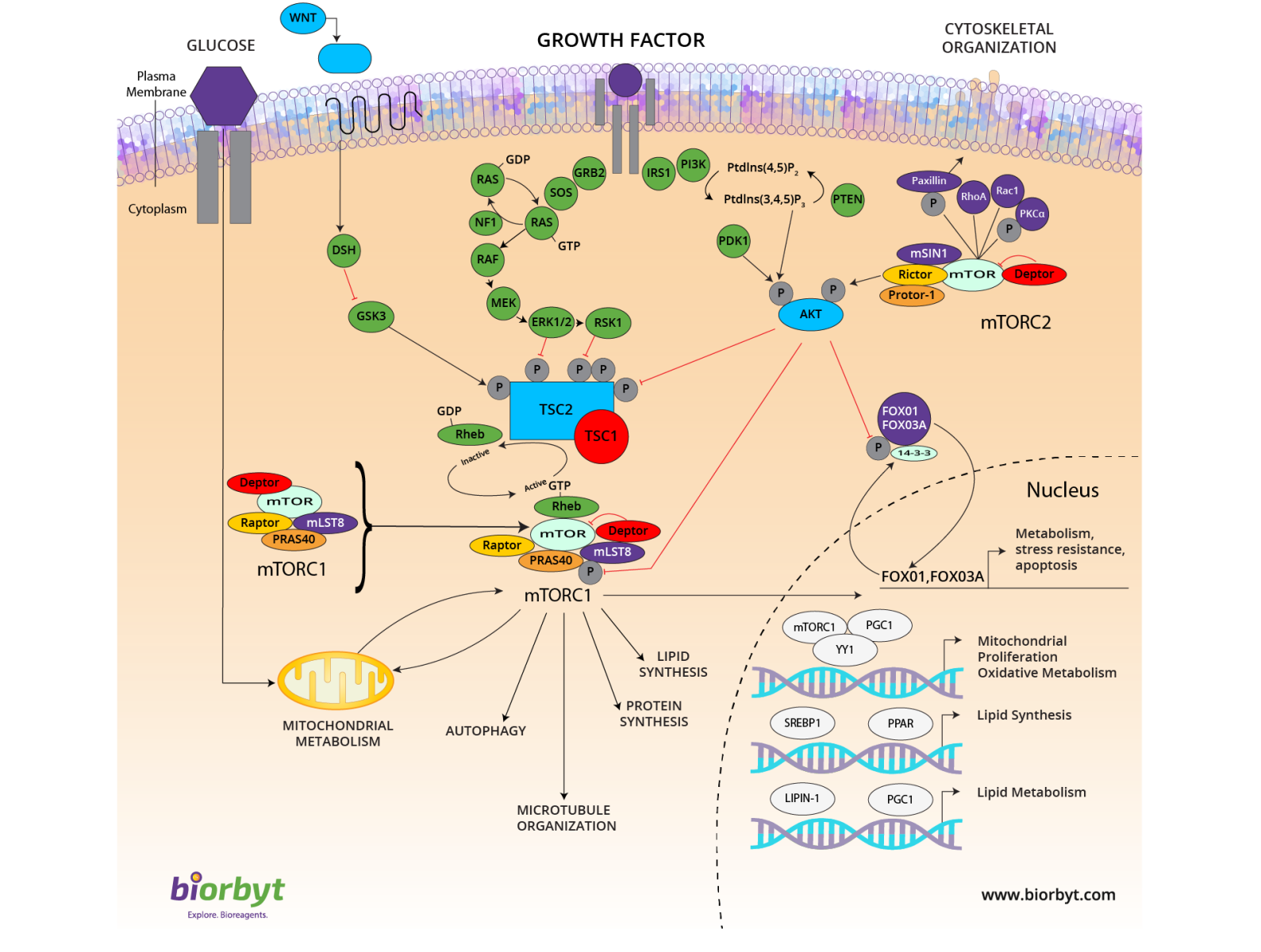
The mechanistic Target of Rapamycin (mTOR) is a critical serine/threonine kinase that integrates environmental signals—including nutrients, energy, and growth factors—to regulate cell growth and metabolism.
mTOR functions within two distinct complexes, mTORC1 and mTORC2, which are defined by their unique accessory proteins and downstream targets. mTOR is a serine/threonine protein kinase in the PI3K-related kinase (PIKK) family that forms the catalytic subunit of these two complexes.
Mapping of the mTOR signalling landscape has revealed that mTOR controls biomass accumulation and metabolism by modulating key cellular processes, including protein synthesis and autophagy. Discoveries over the last decade show that the mTOR pathway is activated during various cellular processes (e.g. tumor formation and angiogenesis, insulin resistance, adipogenesis, and T-lymphocyte activation) and is deregulated in severe human diseases such as cancer and type 2 diabetes.
Importantly, mTORC1 functions as a downstream effector for many frequently mutated oncogenic pathways, including the PI3K/Akt pathway as well as the Ras/Raf/Mek/Erk (MAPK) pathway, resulting in mTORC1 hyperactivation in a high percentage of human cancers.
1. mTOR Signaling Pathway Map
Technical Note: Measuring mTOR Activation
A better and more reliable marker of mTORC1 activation than mTOR Ser2448 is the phosphorylation of its direct downstream substrate S6K1 at Thr389, or the downstream ribosomal protein S6 at Ser235/236.
2. Essential Target Antibodies
Our highly validated antibodies cover the full spectrum of mTOR signaling, from upstream sensors like TSC1/2 to central complex components and downstream effectors.
| Target Molecule | Cat. Code | Validated Applications |
|---|---|---|
| mTOR Antibody | orb13590 | FC, ICC, IF, IHC-Fr, IHC-P, WB |
| Phospho-mTOR (Ser2448) | orb6452 | FC, IF, IHC-Fr, IHC-P |
| DEPTOR | orb2415 | IF, IHC-Fr, IHC-P |
| Raptor | orb6836 | IF, IHC-Fr, IHC-P |
| RICTOR | orb353487 | ELISA, IHC |
| TSC1 (Hamartin) | orb46487 | ELISA, IF, IHC |
| TSC2 (Tuberin) | orb338884 | IF, IHC, WB |
| GSK3β | orb256575 | IHC, IP, WB |
| Ras | orb765761 | ELISA, IF, IHC, WB |
| NF1 | orb214303 | IF, IHC, WB |
3. Bioactive Small Molecules & Inhibitors
Because of its central role in cell proliferation, mTOR is a primary target in oncology. Discover our highly selective inhibitors (Rapalogs and ATP-competitive compounds) to validate your experimental models.
Allosteric Inhibitor
Rapamycin (Sirolimus)
The classical macrolide inhibitor that specifically targets mTORC1, highly validated for inducing autophagy and blocking proliferation.
ATP-Competitive Inhibitor
Torin 1
A highly potent, selective ATP-competitive inhibitor that blocks both mTORC1 and mTORC2 complexes.
Pathway Activator
MHY1485
A cell-permeable small molecule that robustly activates mTOR, suppressing autophagy and promoting cell growth.
Rapalog
Everolimus
A clinically utilized derivative of rapamycin (Rapalog) used heavily in oncology research for targeting mTORC1.
Dual Inhibitor
Dactolisib (NVP-BEZ235)
An active dual pan-PI3K and mTOR kinase inhibitor widely used to overcome feedback resistance in cancer models.
4. Featured Assays, Proteins & Lysates
Beyond primary antibodies and small molecules, Biorbyt offers a comprehensive suite of ELISA kits, active recombinant proteins, and overexpression lysates to streamline your mTOR research.
Quantification
Human mTOR ELISA Kit
A highly sensitive Sandwich ELISA designed to precisely quantify total mTOR levels directly from biological samples.
Recombinant Protein
Human mTOR Protein
High-purity recombinant human mTOR protein intended for structural studies, binding assays, and kinase activity profiling.
Control Lysate
mTOR Over-expression Lysate
Ready-to-use human over-expression lysate, perfectly suited as a robust positive control for Western Blotting applications.
Recombinant Protein
Human LAMTOR1 Protein
Recombinant LAMTOR1, a key component of the Ragulator complex essential for amino acid sensing and mTORC1 activation at the lysosome.