You have no items in your shopping cart.
Human IgM mu chain Antibody
Description
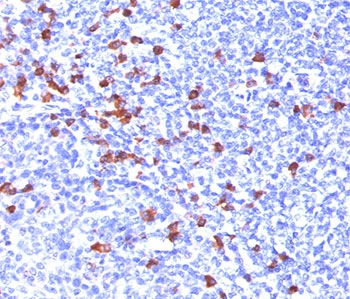
Images & Validation
−| Tested Applications | ELISA, IHC, WB |
|---|---|
| Dilution Range | ELISA: 1:20,000 - 1:100,000, IHC: 1:1,000 - 1:5,000, WB: 1:2,000 - 1:10,000 |
| Reactivity | Human |
| Application Notes |
Key Properties
−| Antibody Type | Secondary Antibody |
|---|---|
| Host | Rabbit |
| Clonality | Polyclonal |
| Isotype | Antiserum |
| Immunogen | Human IgM mu heavy chain |
| Purity | This product was prepared from monospecific antiserum by a delipidation and defibrination. Assay by immunoelectrophoresis resulted in a single precipitin arc against Human IgM and Human Serum. No reaction was observed against Human IgG. |
| Conjugation | Unconjugated |
Storage & Handling
−| Storage | Store vial at 4° C prior to restoration. For extended storage aliquot contents and freeze at -20° C or below. Avoid cycles of freezing and thawing. Centrifuge product if not completely clear after standing at room temperature. This product is stable for several weeks at 4° C as an undiluted liquid. Dilute only prior to immediate use. |
|---|---|
| Form/Appearance | Lyophilized |
| Buffer/Preservatives | 0.01% (w/v) Sodium Azide |
| Concentration | 85 mg/mL |
| Expiration Date | 12 months from date of receipt. |
| Disclaimer | For research use only |
Alternative Names
−Similar Products
−Chicken Human IgM (mu chain specfic), conjugated with FITC Antibody [orb1972314]
IHC
Human
Gallus
FITC
0.5 mgIgM Heavy Chain Antibody [orb248394]
FACS, IF, IHC-P, WB
Human
Mouse
Monoclonal
Unconjugated
100 μg, 20 μg

Quality Guarantee
Explore bioreagents carefree to elevate your research. All our products are rigorously tested for performance. If a product does not perform as described on its datasheet, our scientific support team will provide expert troubleshooting, a prompt replacement, or a refund. For full details, please see our Terms & Conditions and Buying Guide. Contact us at [email protected].

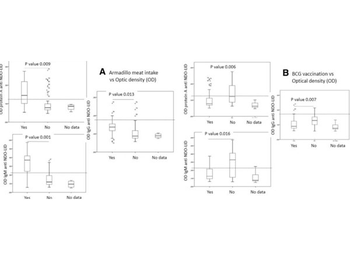
ELISA results using Rabbit Anti-Human IgM. Impact of behavioral variables on M. leprae infection levels. Anti-natural octyl disaccharide-leprosy IDRI diagnostic (NDO-LID) antibody levels in children and adolescents were measured by ELISA, using either protein A, anti- IgM or anti-IgG to detect responses. In a, samples were stratified by recorded knowledge of eating armadillo meat as either yes (n = 14) or no (n = 64). In b, samples were stratified by recorded knowledge of BCG re-vaccination following identification of the index leprosy case as either yes (n = 54) or no (n = 16). Data are displayed as box and whisker plots, with the box representing the Q1 to Q3 interquartile range and the horizontal bar representing the median of the optical density of the samples. Individual dots indicate outliers, and p-values are indicated by the lines above each indicated group.

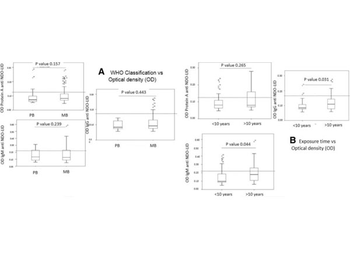
ELISA results using Rabbit Anti-Human IgM. Influence of index case on M. leprae infection levels. Anti-natural octyl disaccharide-leprosy IDRI diagnostic (NDO-LID) antibody levels in children and adolescents were measured by ELISA, using either protein A, anti- IgM or anti-IgG to detect responses. In a, samples were stratified by reported WHO operational classification of the index case as either MB (n = 66) or PB (n = 16). In b, samples were stratified by estimated duration of exposure to the index leprosy case as either less than 10 years (n = 45) or greater than 10 years (n = 37). Data are displayed as box and whisker plots, with the box representing the Q1 to Q3 interquartile range and the horizontal bar representing the median of the optical density of the samples. Individual dots indicate outliers, and p-values are indicated by the lines above each indicated group.

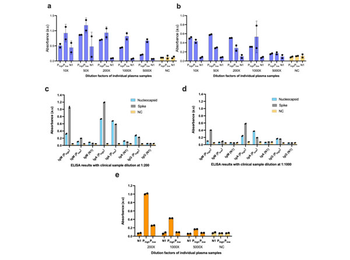
ELISA results using Rabbit Anti-Human IgM. Optimization of the plasma dilutions using clinical plasma samples in a 96- well ELISA format. Serial plasma dilutions were tested in an ELISA plate format with immobilized antigens (a) nucleocapsid and (b) spike protein. Plasma diluted at (c) 200-fold and (d) 1000-fold were compared in ELISA plate formats to detect human IgM, IgA and IgG antibodies against immobilized nucleocapsid and spike protein. Serial plasma dilutions were tested in an ELISA plate format with immobilized S1-RBD to detect human (e) IgM, (f) IgA and (g) IgG. We observed that dilutions between 200X-1000X show a high signal-to-noise ratio in ELISA when detecting IgG against both N and S1 protein antigens (a) and (b), respectively. The dilution factor of 200X (c) detected the less abundant antibody isotypes (IgM and IgA). Similar results were obtained when immobilizing the S1-RBD antigen (e-g), indicating that a dilution factor of 200X was optimal for ELISA experiments. Error bars represent the standard deviation of independent duplicate experiments, biological replicates.
Documents Download
Request a Document
Protocol Information
Human IgM mu chain Antibody (orb750701)
Participating in our Biorbyt product reviews program enables you to support fellow scientists by sharing your firsthand experience with our products.
Login to Submit a Review