
You have no items in your shopping cart.
Description
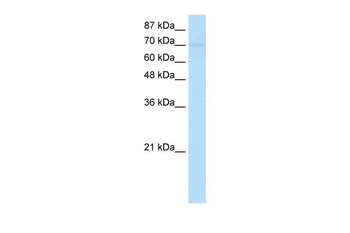
Images & Validation
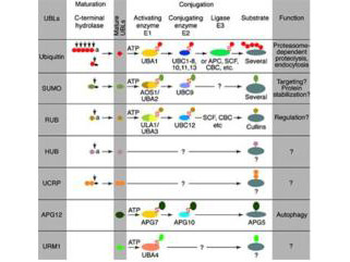
−
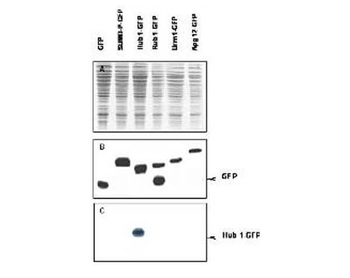
Item 1 of 2
| Tested Applications | ELISA, WB |
|---|---|
| Dilution Range | ELISA: 1:1,000 - 1:5,000, WB: 1:500 - 1:2,000 |
| Reactivity | Yeast |
| Application Notes |
Key Properties
−| Antibody Type | Primary Antibody |
|---|---|
| Host | Rabbit |
| Clonality | Polyclonal |
| Isotype | IgG |
| Immunogen | This purified antibody was prepared from rabbit serum after repeated immunizations with recombinant yeast Hub1 protein. |
| Target | HUB1 |
| Purity | This product is an IgG fraction antibody purified from monospecific antiserum by a multi-step process which includes delipidation, salt fractionation and ion exchange chromatography followed by extensive dialysis against the buffer stated above. Assay by immunoelectrophoresis resulted in a single precipitin arc against anti-Rabbit Serum. |
| Conjugation | Unconjugated |
Storage & Handling
−| Storage | Store vial at 4° C prior to restoration. For extended storage aliquot contents and freeze at -20° C or below. Avoid cycles of freezing and thawing. Centrifuge product if not completely clear after standing at room temperature. This product is stable for several weeks at 4° C as an undiluted liquid. Dilute only prior to immediate use. |
|---|---|
| Form/Appearance | Lyophilized |
| Buffer/Preservatives | Preservative: 0.01% (w/v) Sodium Azide. Stabilizer: None; Buffer: 0.02 M Potassium Phosphate, 0.15 M Sodium Chloride, pH 7.2 |
| Concentration | 5.0 mg/mL |
| Expiration Date | 12 months from date of receipt. |
| Disclaimer | For research use only |
Alternative Names
−rabbit anti-Hub1 Antibody, rabbit anti-Hub 1 Antibody, Homologous to UBiquitin antibody, Hub1 protein antibody, HUB1 target protein 1 antibody, Hub1p antibody, Ubiquitin like protein modifier antibody
Similar Products
−- Item 1 of 2
ZNF282 Rabbit Polyclonal Antibody [orb576643]
WB
Bovine, Canine, Equine, Guinea pig, Mouse, Porcine, Rabbit, Rat, Zebrafish
Human
Rabbit
Polyclonal
Unconjugated
100 μl - Item 1 of 1
ZNF282 Rabbit Polyclonal Antibody [orb576642]
WB
Canine, Guinea pig, Mouse, Rabbit, Rat
Human
Rabbit
Polyclonal
Unconjugated
100 μl 
ZNF282 Rabbit Polyclonal Antibody [orb313595]
ELISA, ICC, IF, IHC-Fr, IHC-P, WB
Bovine, Canine, Human, Mouse, Rat
Human
Rabbit
Polyclonal
Unconjugated
200 μl, 50 μl, 100 μlZNF282 Rabbit Polyclonal Antibody (HRP) [orb475678]
ELISA, IHC-Fr, IHC-P, WB
Bovine, Canine, Human, Mouse, Rat
Rabbit
Polyclonal
HRP
100 μlZNF282 Rabbit Polyclonal Antibody (PE-Cy5.5) [orb965562]
ICC, IF
Bovine, Canine, Human, Mouse, Rat
Rabbit
Polyclonal
PE/Cy5.5
100 μl

Quality Guarantee
Explore bioreagents carefree to elevate your research. All our products are rigorously tested for performance. If a product does not perform as described on its datasheet, our scientific support team will provide expert troubleshooting, a prompt replacement, or a refund. For full details, please see our Terms & Conditions and Buying Guide. Contact us at [email protected].
Protocol Information
WB
Western Blot (IB, immunoblot)
ELISA
Enzyme-linked Immunosorbent Assay (EIA)
Available Sizes
Select a size below
Free Secondary Antibody (20 ul)0/0
Please add an antibody product to your cart first.
 Usually dispatched within 5-10 working days