Cart summary

You have no items in your shopping cart.

Kaempferol

SKU: orb1224825

Description

Kaempferol is a natural flavonol, a type of flavonoid, that has been isolated from plant sources.(In Vitro):Kaempferol also has anti-inflammatory effects via inhibition of interleukin-4 and cyclo-oxygenase 2 expression by suppressing Src kinase and downregulating the NFκB pathway. Kaempferol is also effective in inhibiting angiogenesis and inducing apoptosis in ovarian cancer cells. Kaempferol is a natural flavonoid that is widely distributed in fruits and vegetables, and prospective studies revealed that over decades, consumption of Kaempferol dramatically and significantly reduces the risk of ovarian cancer in American female nurses. After a 24-hour treatment, Kaempferol causes a significant and concentration-dependent inhibition of proliferation in all 3 ovarian cancer cells tested. This inhibition is observed at 40 μM or higher concentrations of treatment. Kaempferol is a flavonoid which is abundant in a variety of plant derived food and leaves used in traditional medicines. Kaempferol significantly inhibits NADPH oxidase activity. Kaempferol decrease reactive oxygen species (ROS) by directly bound NADPH oxidase. Kaempferol prevents Ang II-induced sinus nodal cell death by lowering CAMKII oxidization.10-20 μM Kaempferol dose-dependently suppresses its release in sensitized RBL-2H3 cells. When 10-20 μM Kaempferol is supplemented to DNP-BSA-challenged RBL-2H3 cells for 15 min, the activation of Syk and PLCγ is highly attenuated. When ≥10 μM Kaempferol is added to DNP-BSA-challenged RBL-2H3 cells for 60 min, the COX2 induction is reduced.(In Vivo):The COX2 induction is confirmed in the airways of BSA-challenged BALB/c mice. There is lack of COX2 in airways of untreated control mice observed. The BSA inhalation to mice led to enhanced COX2 induction (dark brown staining) in mouse airway, which is reversed by oral administration of Kaempferol. In BSA-challenged mice, there is a marked goblet cell hyperplasia and epithelial thickening observed. When 20 mg/kg Kaempferol is supplemented to BSA-challenged mice, the epithelial thickening completely disappeared.

Images & Validation

Key Properties

CAS Number520-18-3
MW286.23
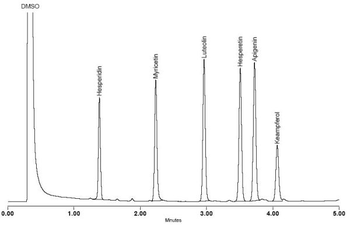
Purity>98% (HPLC)
FormulaC15H10O6
SMILESO=C1C(O)=C(C2=CC=C(O)C=C2)OC3=CC(O)=CC(O)=C13
TargetEstrogen Receptor/ERR
SolubilityEthanol: 57 mg/mL (199.14 mM); DMSO: 57 mg/mL (199.14 mM)

Storage & Handling

StorageStorage temperature: -20°C. Stability: ≥ 2 years
Expiration Date12 months from date of receipt.
DisclaimerFor research use only

Alternative Names

Nimbecetin | NSC 407289 | NSC 656277 | Pelargidenon | Rhamnolutein | Swartziol | Trifolitin

Similar Products

Quality Guarantee

Quality Guarantee

Explore bioreagents carefree to elevate your research. All our products are rigorously tested for performance. If a product does not perform as described on its datasheet, our scientific support team will provide expert troubleshooting, a prompt replacement, or a refund. For full details, please see our Terms & Conditions and Buying Guide. Contact us at [email protected].

Documents Download

Datasheet
Product Information
Download

Request a Document

Protocol Information

Kaempferol (orb1224825)

  • Star
  • Star
  • Star
  • Star
  • Star
  • 0.0
Based on 0 reviews

Participating in our Biorbyt product reviews program enables you to support fellow scientists by sharing your firsthand experience with our products.

Login to Submit a Review

No reviews yet

Step 1: Enter information below

(Recommended: An additional animal making an allowance for loss during the experiment)

Step 2: Enter the in vivo formulation

(This is only the calculator, not formulation. Please contact us first if there is no in vivo formulation at the solubility Section.)

% DMSO +
%+
% Tween 80 +
%

Available Sizes

Select a size below

50 mg
$ 90.00
100 mg
$ 100.00
200 mg
$ 140.00
500 mg
$ 260.00