Queen's Award Received in 2021 ISO 9001 Certified Delivered over 1,000,000 bio-reagents to life science researchers Trusted by Life Science Communities
Cart summary

You have no items in your shopping cart.

Spiramycin

SKU: orb1310264

Description

Spiramycin is a macrolide antibiotic derived from Streptomyces ambofaciens, effective against Gram-positive aerobes, Neisseria gonorrhoeae, and staphylococci. It is utilized in research for studying bacterial and Toxoplasma gondii infections, with applications in both in vitro antimicrobial assays and in vivo experimental models.

Research Area

Infectious Disease & Virology

Images & Validation

Key Properties

CAS Number8025-81-8
MW843.07
Purity97.92% (May vary between batches)
FormulaC43H74N2O14
SMILESCOC1C(O)CC(=O)OC(C)CC=CC=CC(OC2CCC(C(C)O2)N(C)C)C(C)CC(CC=O)C1OC1OC(C)C(OC2CC(C)(O)C(O)C(C)O2)C(C1O)N(C)C
TargetAntibacterial|||Parasite|||Antibiotic
SolubilityH2O:< 1 mg/mL (insoluble or slightly soluble);Ethanol:93 mg/mL (110.31 mM);DMSO:252.5 mg/mL (299.5 mM);10% DMSO+40% PEG300+5% Tween 80+45% Saline:3.3 mg/mL (3.91 mM)

Bioactivity

In Vivo
Spiramycin acts by binding to the bacterial 50S ribosomal subunit, thereby inhibiting translocation. Its primary mechanism during translocation involves stimulating the dissociation of peptidyl-tRNA from the ribosome. The compound reduces the protective effect of anisomycin on 23S rRNA nucleotides. Spiramycin exhibits potent antibacterial activity against the genus Prevotella, Streptococcus mitis, Archaea, strains of Porphyromonas, and Bacteroides, with metronidazole enhancing its efficacy. At 30°C, Spiramycin can inhibit protein synthesis in wild-type cells but not kill mutant or wild-type cells. Treating lipopolysaccharide-stimulated human monocytes with Spiramycin and erythromycin increases the total production of IL-6 without affecting TNFα, IL-1α, or IL-1β production. Spiramycin inhibits protein synthesis by stimulating the dissociation of peptidyl-tRNA from ribosomes. It dose-dependently inhibits the proliferative response of human mononuclear cells stimulated by pulse-width modulation and polyhydroxyalkanoate esters. Additionally, Spiramycin induces a reduction in tritiated thymidine uptake, suggesting interference with an early stage of the cell cycle.

Storage & Handling

Storage-20°C
Expiration Date12 months from date of receipt.
DisclaimerFor research use only

Alternative Names

Antibiotic, Bacterial, Formacidine, Espiramicin, Parasite, Spiramycin, Rovamycin, Provamycin, Sequamycin

Similar Products

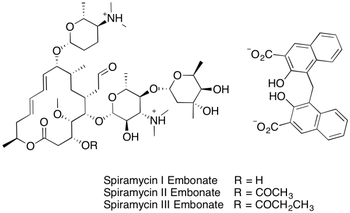
  • Spiramycin Embonate [orb321183]

    Spiramycin 67-73%, embonic acid 27-33%

    67724-08-7

    C23H16O6-Unspecified

    1 g, 5 g
  • 4"-(2-(p-Chlorophenyl)acetoxyl)spiramycin [orb2945070]

    995.63

    C51H79ClN2O15

    10 mg, 50 mg
  • Antibacterial agent 193 [orb3133717]

    C23H18O4

    10 mg, 50 mg
  • Spiramycin I [orb3171874]

    24916-50-5

    843.05

    C43H74N2O14

    100 mg, 500 mg
  • Neospiramycin [orb1985551]

    4617-99-6

    754.959

    C39H66N2O12

    100 mg, 500 mg
Quality Guarantee

Quality Guarantee

Explore bioreagents carefree to elevate your research. All our products are rigorously tested for performance. If a product does not perform as described on its datasheet, our scientific support team will provide expert troubleshooting, a prompt replacement, or a refund. For full details, please see our Terms & Conditions and Buying Guide. Contact us at [email protected].

Key Properties

No computed properties available.

Protocol Information

Available Sizes

Select a size below

1 ml x 10 mM (in DMSO)
$ 70.00
500 mg
$ 80.00
DispatchUsually dispatched within 5-10 working days
Bulk Enquiry