Queen's Awards Received in 2021 ISO 9001 Certified Delivered over 1,000,000 bio-reagents to life science researchers Trusted by Life Science Communities
Cart summary

You have no items in your shopping cart.

Sodium Hyaluronate

SKU: orb1221264

Description

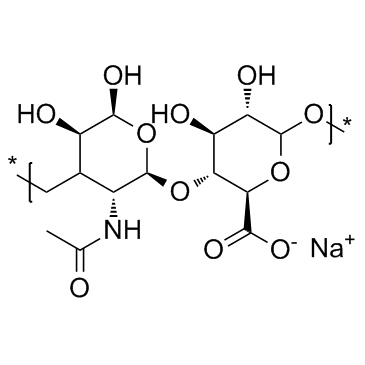
Hyaluronic acid (HA) is an anionic nonsulfated glycosaminoglycan distributed widely throughout connective epithelial and neural tissues. It is unique among glycosaminoglycans in that it is nonsulfated forms in the plasma membrane instead of the Golgi and can be very large with its molecular weight often reaching the millions. One of the chief components of the extracellular matrix hyaluronic acid contributes significantly to cell proliferation and migration and may also be involved in the progression of some malignant tumors.(In Vitro):Hyaluronic acid (HA) is widely used in aesthetic medicine due to its binding ability with a large number of water molecules. It improves tissue hydration and their resistance to mechanical damage. HA plays an important role in wound healing, ovulation, fertilization, signal transduction, and tumor physiology. HA is used in joint diseases such as osteoarthritis or rheumatoid arthritis. HA of a high molecular mass reduces the chemotaxis and migration of inflammatory cells which acts as a good barrier to the inflammatory process and protects against the effects of free radicals. HA is used in ophthalmology due to its lubricating properties for the corneal endothelium, and improves tissue hydration and cellular resistance to mechanical damage in aesthetic dermatology, and has marginal adverse effects. Several trials indicate its role in tumor markers, liver diseases, and in pharmaceuticals. Hyaluronan plays an important role in cancer growth and metastasis. HA and HA fragment-tumor cell interaction could activate the downstream signaling pathways, promoting cell proliferation, adhesion, migration and invasion, and inducing angiogenesis, lymphangiogenesis, epithelial-mesenchymal transition, stem cell-like property, and chemoradioresistance in digestive cancers.(In Vivo):The impact of applied intra-articular HA has been proven in many studies in animals. Studies on HA have shown that it promotes the synthesis of cartilage matrix, prevents its degradation, reduces inflammation, stimulates the synthesis of endogenous HA, and improves the resilience and moisture of cartilage. High molecular size HA preparations, applied topically, promote healing of fresh skin wounds. They also promote the healing of venous leg ulcers and are useful in the management of chronic wounds.

Images & Validation

Key Properties

CAS Number9067-32-7
MW403.31
Purity>98% (HPLC)
FormulaC14H22NNaO11
TargetOthers
SolubilityDMSO:10 mM

Bioactivity

In Vivo
The impact of applied intra-articular HA has been proven in many studies in animals. Studies on HA have shown that it promotes the synthesis of cartilage matrix, prevents its degradation, reduces inflammation, stimulates the synthesis of endogenous HA, and improves the resilience and moisture of cartilage. High molecular size HA preparations, applied topically, promote healing of fresh skin wounds. They also promote the healing of venous leg ulcers and are useful in the management of chronic wounds.
In Vitro
Hyaluronic acid (HA) is widely used in aesthetic medicine due to its binding ability with a large number of water molecules. It improves tissue hydration and their resistance to mechanical damage. HA plays an important role in wound healing, ovulation, fertilization, signal transduction, and tumor physiology. HA is used in joint diseases such as osteoarthritis or rheumatoid arthritis. HA of a high molecular mass reduces the chemotaxis and migration of inflammatory cells which acts as a good barrier to the inflammatory process and protects against the effects of free radicals. HA is used in ophthalmology due to its lubricating properties for the corneal endothelium, and improves tissue hydration and cellular resistance to mechanical damage in aesthetic dermatology, and has marginal adverse effects. Several trials indicate its role in tumor markers, liver diseases, and in pharmaceuticals. Hyaluronan plays an important role in cancer growth and metastasis. HA and HA fragment-tumor cell interaction could activate the downstream signaling pathways, promoting cell proliferation, adhesion, migration and invasion, and inducing angiogenesis, lymphangiogenesis, epithelial-mesenchymal transition, stem cell-like property, and chemoradioresistance in digestive cancers.

Storage & Handling

StorageStorage temperature: -20°C. Stability: ≥ 2 years
Expiration Date12 months from date of receipt.
DisclaimerFor research use only

Alternative Names

Hyaluronic acid sodium salt

Similar Products

  • HAS2 monoclonal antibody [orb1676986]

    WB

    Human

    Mouse

    Monoclonal

    Unconjugated

    200 μl, 50 μl, 100 μl
  • CD44 monoclonal antibody [orb1677256]

    FC,  IF,  IHC,  WB

    Human

    Mouse

    Monoclonal

    Unconjugated

    200 μl, 50 μl, 100 μl
  • CD44 monoclonal antibody [orb1677593]

    IF,  IHC,  IP,  WB

    Human

    Mouse

    Monoclonal

    Unconjugated

    200 μl, 50 μl, 100 μl
  • Hyaluronic acid sodium [orb1302240]

    98.00% (May vary between batches)

    9067-32-7

    292.372

    C14H28O6

    100 mg, 500 mg, 1 g
  • Hyaluronic acid sodium (MW 2,000,000 kDa) [orb2663712]

    2,000,000 kDa

    100 mg, 10 mg, 5 mg, 50 mg, 25 mg, 500 mg
Quality Guarantee

Quality Guarantee

Explore bioreagents carefree to elevate your research. All our products are rigorously tested for performance. If a product does not perform as described on its datasheet, our scientific support team will provide expert troubleshooting, a prompt replacement, or a refund. For full details, please see our Terms & Conditions and Buying Guide. Contact us at [email protected].

Sodium Hyaluronate

Sodium Hyaluronate

Documents Download

Datasheet
Product Information
Download

Request a Document

Protocol Information

Sodium Hyaluronate (orb1221264)

  • Star
  • Star
  • Star
  • Star
  • Star
  • 0.0
Based on 0 reviews

Participating in our Biorbyt product reviews program enables you to support fellow scientists by sharing your firsthand experience with our products.

Login to Submit a Review

No reviews yet

Step 1: Enter information below

(Recommended: An additional animal making an allowance for loss during the experiment)

Step 2: Enter the in vivo formulation

(This is only the calculator, not formulation. Please contact us first if there is no in vivo formulation at the solubility Section.)

% DMSO +
%+
% Tween 80 +
%

Available Sizes

Select a size below

50 mg
$ 100.00
100 mg
$ 130.00
200 mg
$ 150.00
500 mg
$ 220.00
1 g
$ 270.00
DispatchUsually dispatched within 5-10 working days
Bulk Enquiry