
You have no items in your shopping cart.
Rat TNF Alpha/Tumor necrosis factor ELISA Kit
SKU: orb50112
Description
Research Area
Cancer Biology, Cancer Biology; Immunology & Inflammation, Cardiovascular Research, Immunology & Inflammation, Metabolism Research, Signal Transduction
Images & Validation
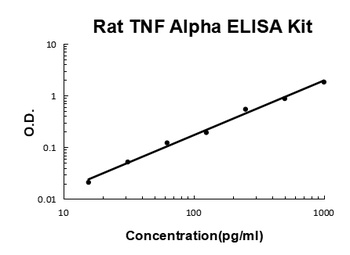
−
Item 1 of 1
| Tested Applications | ELISA |
|---|
Key Properties
−| Reactivity | Rat |
|---|---|
| Sample Types | cell culture supernatants, cell lysates, serum and plasma (heparin, EDTA). |
| Range | 15.6 pg/ml - 1,000 pg/ml |
| Sensitivity | <1 pg/ml |
Storage & Handling
−| Storage | Store at 4°C for 6 months, at -20°C for 12 months. Avoid multiple freeze-thaw cycles (Ships with gel ice, can store for up to 3 days in room temperature. Freeze upon receiving.) |
|---|---|
| Expiration Date | 6 months from date of receipt. |
| Disclaimer | For research use only |
Alternative Names
−Tumor necrosis factor; Cachectin; TNF-alpha; Tumor necrosis factor ligand superfamily member 2; TNF-a; Tumor necrosis factor, membrane form; N-terminal fragment; NTF; Intracellular domain 1; ICD1; Intracellular domain 2; ICD2; C-domain 1; C-domain 2; Tumor necrosis factor, soluble form; Tnf; Tnfa, Tnfsf2
Similar Products
−- Item 1 of 1
- Item 1 of 1
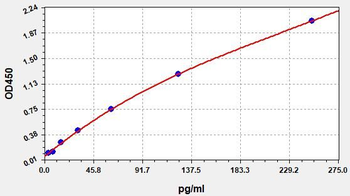
FS-Rat TNF-α(Tumor Necrosis Factor Alpha) ELISA Kit [orb3200393]
Rat
0.78-50pg/mL
0.43pg/mL
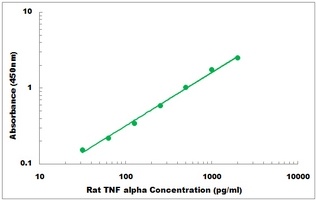
48 T, 96 TRat TNF Alpha/Tumor necrosis factor High Sensitivity ELISA Kit [orb3130821]
Rat
1.56 pg/ml - 100 pg/ml
0.006pg/ml
96 T

Quality Guarantee
Explore bioreagents carefree to elevate your research. All our products are rigorously tested for performance. If a product does not perform as described on its datasheet, our scientific support team will provide expert troubleshooting, a prompt replacement, or a refund. For full details, please see our Terms & Conditions and Buying Guide. Contact us at [email protected].
Quick Database Links
Gene Symbol
Tumor necrosis factor
UniProt
UniProt Details
− No UniProt data available
Liang, Huoyan et al. Adipose-derived mesenchymal stem cells ameliorate acute liver injury in rat model of CLP induced-sepsis via sTNFR1 Exp. Cell Res., (2019)
Available Sizes
Select a size below
 Usually dispatched within 2-4 weeks