Cart summary

You have no items in your shopping cart.

Quinolinic acid

SKU: orb1303166

Description

Quinolinic acid is an endogenous excitotoxin produced through the kynurenine pathway of tryptophan metabolism. It acts as a selective NMDA receptor agonist, making it a valuable research tool for studying excitotoxicity, neurodegenerative diseases, and neuroinflammation in both in vitro and in vivo models.

Research Area

Metabolism Research, Neuroscience, Pharmacology & Drug Discovery

Images & Validation

Key Properties

CAS Number89-00-9
MW167.12
Purity99.98% (May vary between batches)
FormulaC7H5NO4
SMILESOC(=O)C1=C(N=CC=C1)C(O)=O
TargetiGluR,Endogenous Metabolite,NMDAR
SolubilityDMSO:250 mg/mL (1495.93 mM);10% DMSO+40% PEG300+5% Tween 80+45% Saline:2 mg/mL (11.97 mM)

Bioactivity

In Vivo
Quinolinic acid (QUIN), a neuroactive metabolite of the kynurenine pathway, is normally presented in nanomolar concentrations in human brain and cerebrospinal fluid (CSF) and is often implicated in the pathogenesis of a variety of human neurological diseases. The concentration of QUIN varies among different brain regions, with the cerebral cortex containing approximately 1.8 nmol/g wet weight; almost 2-fold than that found in the hippocampus (1 nmol/g wet weight). Intraarterial administration of either micromolar or millimolar concentrations of QUIN results in only negligible accumulations of this metabolite in the brain, suggesting that the central nervous system (CNS) appears to be well protected by the blood-brain barrier (BBB) from peripheral QUIN. QUIN can also increase glutamate release and inhibit its reuptake by astrocytes, thus increasing its concentration in the microenvironments, causing neurotoxicity and also limiting glutamate to glutamine recycling in astrocytes by decreasing glutamine synthetase activity. Intrastriatal injection of QUIN provokes a decrease in cellular respiration and ATP levels .
In Vitro
QUIN has an uptake system, its neuronal degradation enzyme is rapidly saturated, and the rest of the extracellular QUIN can continue stimulating the NMDA receptor. QUIN (10 μM) prevents of glutamate-induced excitotoxicity in primary cultures of rat cerebellar granule neurons, nevertheless mature organotypic cultures of rat corticostriatal system or caudate nucleus chronically exposed to 100 nM QUIN for up to 7 weeks show focal degeneration characterized by the presence of vacuoles in neuropil, swollen dendrites, occasional swollen post-synaptic elements, and degenerated neurons. In vitro QUIN treatment of human primary fetal neurons leads to a substantial increase of tau phosphorylation at multiple positions. The increase in QUIN-induced phosphorylation of tau is attributed to a decrease in the expression and activity of the major tau phosphatases. QUIN can inhibit B monoamine oxidase (MAO-B) in human brain synaptosomal mitochondria and also can be a potent inhibitor of phosphoenolpyruvate carboxykinase (EC 4.1.1.32) from rat liver cytoplasm, an important enzyme in the gluconeogenesis pathway that converts oxaloacetate to phosphoenolpyruvate. QUIN can increase free radical production by inducing NOS activity in astrocytes and neurons, leading to oxidative stress, increasing both poly(ADP-ribose) polymerase (PARP) activity and extracellular lactate dehydrogenase (LDH) activity .

Storage & Handling

StoragePowder: -20°C for 3 years | In solvent: -80°C for 1 year | Shipping with blue ice/Shipping at ambient temperature.
Expiration Date12 months from date of receipt.
DisclaimerFor research use only

Alternative Names

pyridine-2,3-dicarboxylic acid, QUIN, Quinolinic acid, NMDA receptor, Endogenous Metabolite, EndogenousMetabolite, iGluR

Similar Products

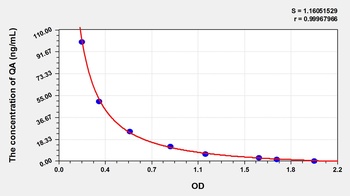
  • General Quinolinic Acid (QA) ELISA Kit [orb781977]

    All

    1.57-100 ng/mL

    0.54 ng/mL

    96 T, 48 T
  • Rat Quinolinic Acid (QA) ELISA Kit [orb1173583]

    Rat

    1.57-100 ng/mL

    0.57 ng/mL

    96 T, 48 T
  • Human Quinolinic Acid (QA) ELISA Kit [orb1496490]

    Human

    1.57-100 ng/mL

    0.57 ng/mL

    48 T, 96 T
  • Ac-Leu-Val-Lys-Aldehyde [orb1980843]

    384.51

    5 mg, 50 mg
  • Quinolinic acid (Standard) [orb3141330]

    89-00-9

    167.12

    C7H5NO4

    100 mg
Quality Guarantee

Quality Guarantee

Explore bioreagents carefree to elevate your research. All our products are rigorously tested for performance. If a product does not perform as described on its datasheet, our scientific support team will provide expert troubleshooting, a prompt replacement, or a refund. For full details, please see our Terms & Conditions and Buying Guide. Contact us at [email protected].

Key Properties

No computed properties available.

Documents Download

Datasheet
Product Information
Download

Request a Document

Protocol Information

Quinolinic acid (orb1303166)

  • Star
  • Star
  • Star
  • Star
  • Star
  • 0.0
Based on 0 reviews

Participating in our Biorbyt product reviews program enables you to support fellow scientists by sharing your firsthand experience with our products.

Login to Submit a Review

No reviews yet

Step 1: Enter information below

(Recommended: An additional animal making an allowance for loss during the experiment)

Step 2: Enter the in vivo formulation

(This is only the calculator, not formulation. Please contact us first if there is no in vivo formulation at the solubility Section.)

% DMSO +
%+
% Tween 80 +
%

Available Sizes

Select a size below

1 g
$ 70.00
1 ml x 10 mM (in DMSO)
$ 90.00
DispatchUsually dispatched within 3-5 working days
Bulk Enquiry