You have no items in your shopping cart.
CD146/MCAM Antibody (monoclonal, 4C12)
Description
Images & Validation
−| Tested Applications | FC, IHC, IHC-Fr, WB |
|---|---|
| Reactivity | Human |
| Application Notes |
Key Properties
−| Antibody Type | Primary Antibody |
|---|---|
| Host | Mouse |
| Clonality | Monoclonal |
| Isotype | Mouse IgG2a |
| Clone No. | 4C12 |
| Immunogen | E.coli-derived human CD146 recombinant protein (Position: H59-A401). Human CD146 shares 73% amino acid (aa) sequence identity with both mouse and rat CD146. |
| Molecular Weight | 120 kDa |
| Purification | Immunogen affinity purified. |
| Conjugation | Unconjugated |
Storage & Handling
−| Storage | Maintain refrigerated at 2-8°C for up to 2 weeks. For long term storage store at -20°C in small aliquots to prevent freeze-thaw cycles. |
|---|---|
| Form/Appearance | Lyophilized |
| Concentration | Adding 0.2 ml of distilled water will yield a concentration of 500 μg/ml. |
| Disclaimer | For research use only |
Alternative Names
−Similar Products
−Anti-CD146/MCAM Antibody (monoclonal, 4C12) [orb2606806]
FC, IHC, IHC-Fr, WB
Human
Mouse
Monoclonal
iFluor647
100 μgCD146/MCAM Antibody (monoclonal, 4C12) [orb2606807]
FC, IHC, IHC-Fr, WB
Human
Mouse
Monoclonal
PE
100 μgCD146/MCAM Antibody (monoclonal, 4C12) [orb2606808]
FC, IHC, IHC-Fr, WB
Human
Mouse
Monoclonal
APC
100 μgAnti-CD146/MCAM Antibody (monoclonal, 4C12) [orb2606809]
FC, IHC, IHC-Fr, WB
Human
Mouse
Monoclonal
HRP
100 μgAnti-CD146/MCAM Antibody (monoclonal, 4C12) [orb2606810]
FC, IHC, IHC-Fr, WB
Human
Mouse
Monoclonal
FITC
100 μg

Quality Guarantee
Explore bioreagents carefree to elevate your research. All our products are rigorously tested for performance. If a product does not perform as described on its datasheet, our scientific support team will provide expert troubleshooting, a prompt replacement, or a refund. For full details, please see our Terms & Conditions and Buying Guide. Contact us at [email protected].

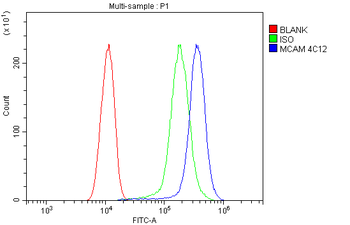
Flow Cytometry analysis of SiHa cells using anti-CD146/MCAM antibody. Overlay histogram showing SiHa cells (Blue line). The cells were fixed with 4% paraformaldehyde and blocked with 10% normal goat serum. And then incubated with mouse anti-CD146/MCAM Antibody (1 µg/1x10^6 cells) for 30 min at 20°C. DyLight®488 conjugated goat anti-mouse IgG (5-10 µg/1x10^6 cells) was used as secondary antibody for 30 minutes at 20°C. Isotype control antibody (Green line) was mouse IgG (1 µg/1x10^6) used under the same conditions. Unlabelled sample without incubation with primary antibody and secondary antibody (Red line) was used as a blank control.

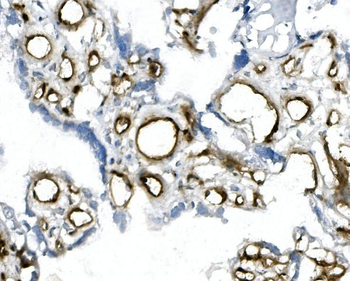
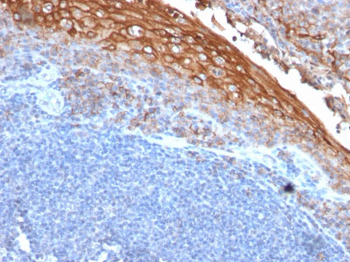
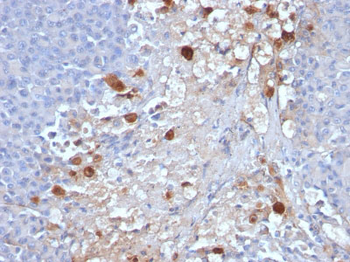
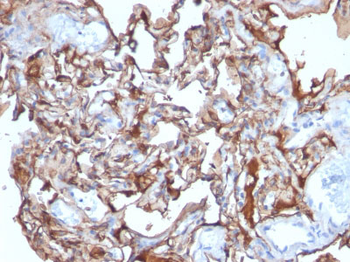
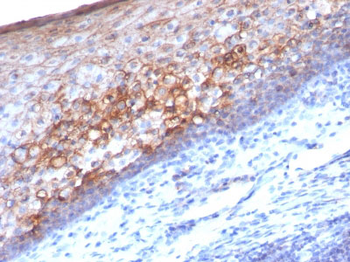
IHC analysis of CD146/MCAM using anti-CD146/MCAM antibody. CD146/MCAM was detected in frozen section of human placenta tissue. The tissue section was blocked with 10% goat serum. The tissue section was then incubated with 1 µg/ml mouse anti-CD146/MCAM Antibody overnight at 4°C. Biotinylated goat anti-mouse IgG was used as secondary antibody and incubated for 30 minutes at 37°C. The tissue section was developed using Strepavidin-Biotin-Complex (SABC) with DAB as the chromogen.

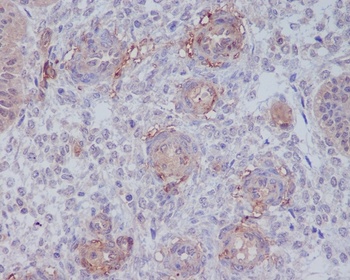
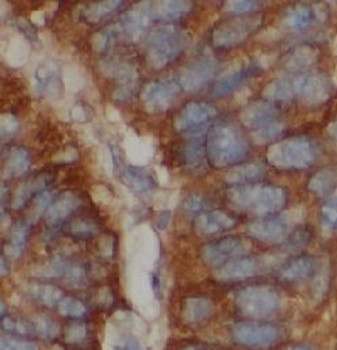
IHC analysis of CD146/MCAM using anti-CD146/MCAM antibody. CD146/MCAM was detected in paraffin-embedded section of human mammary cancer tissue. Heat mediated antigen retrieval was performed in EDTA buffer (pH8.0, epitope retrieval solution). The tissue section was blocked with 10% goat serum. The tissue section was then incubated with 1 µg/ml mouse anti-CD146/MCAM Antibody overnight at 4°C. Biotinylated goat anti-mouse IgG was used as secondary antibody and incubated for 30 minutes at 37°C. The tissue section was developed using Strepavidin-Biotin-Complex (SABC) with DAB as the chromogen.

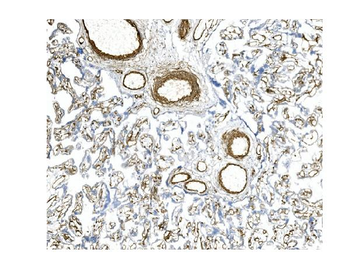
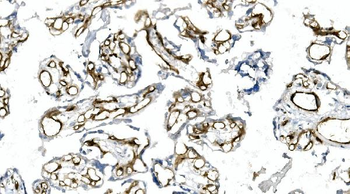
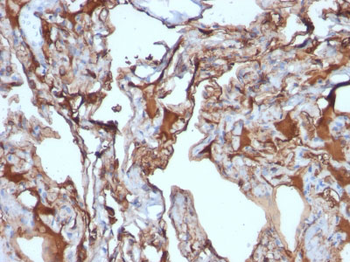
IHC analysis of CD146/MCAM using anti-CD146/MCAM antibody. CD146/MCAM was detected in paraffin-embedded section of human placenta tissue. Heat mediated antigen retrieval was performed in EDTA buffer (pH8.0, epitope retrieval solution). The tissue section was blocked with 10% goat serum. The tissue section was then incubated with 1 µg/ml mouse anti-CD146/MCAM Antibody overnight at 4°C. Biotinylated goat anti-mouse IgG was used as secondary antibody and incubated for 30 minutes at 37°C. The tissue section was developed using Strepavidin-Biotin-Complex (SABC) with DAB as the chromogen.

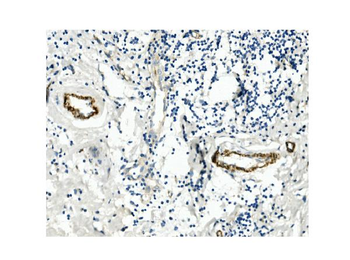
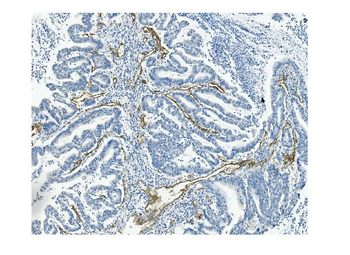
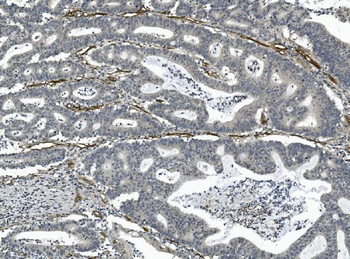
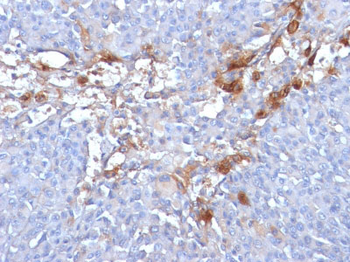
IHC analysis of CD146/MCAM using anti-CD146/MCAM antibody. CD146/MCAM was detected in paraffin-embedded section of human rectal cancer tissue. Heat mediated antigen retrieval was performed in EDTA buffer (pH8.0, epitope retrieval solution). The tissue section was blocked with 10% goat serum. The tissue section was then incubated with 1 µg/ml mouse anti-CD146/MCAM Antibody overnight at 4°C. Biotinylated goat anti-mouse IgG was used as secondary antibody and incubated for 30 minutes at 37°C. The tissue section was developed using Strepavidin-Biotin-Complex (SABC) with DAB as the chromogen.

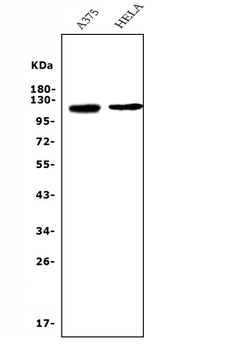
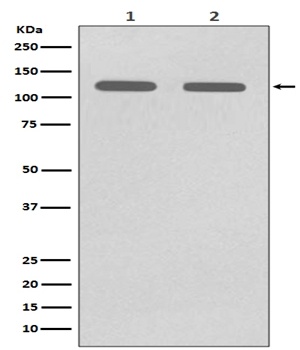
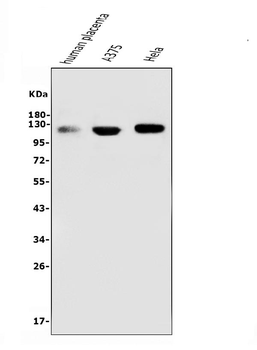
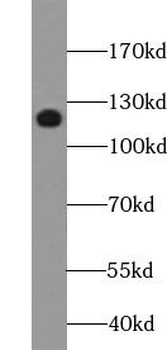
Western blot analysis of CD146/MCAM using anti-CD146/MCAM antibody. Electrophoresis was performed on a 5-20% SDS-PAGE gel at 70V (Stacking gel) / 90V (Resolving gel) for 2-3 hours. The sample well of each lane was loaded with 50 ug of sample under reducing conditions. Lane 1: human A375 whole cell lysates; Lane 2: human Hela whole cell lysates. After Electrophoresis, proteins were transferred to a Nitrocellulose membrane at 150 mA for 50-90 minutes. Blocked the membrane with 5% Non-fat Milk/ TBS for 1.5 hour at RT. The membrane was incubated with mouse anti-CD146/MCAM antigen affinity purified monoclonal antibody at 0.5 µg/mL overnight at 4°C, then washed with TBS-0.1% Tween 3 times with 5 minutes each and probed with a goat anti-mouse IgG-HRP secondary antibody at a dilution of 1:10000 for 1.5 hour at RT. The signal is developed using an Enhanced Chemiluminescent detection (ECL) kit with Tanon 5200 system. A specific band was detected for CD146/MCAM at approximately 120 KD. The expected band size for CD146/MCAM is at 72 KD.
Quick Database Links
UniProt Details
−Documents Download
Request a Document
Protocol Information
CD146/MCAM Antibody (monoclonal, 4C12) (orb654279)
Participating in our Biorbyt product reviews program enables you to support fellow scientists by sharing your firsthand experience with our products.
Login to Submit a Review