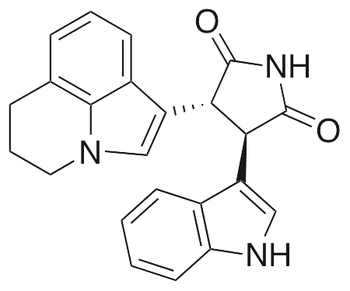
Tivantinib (ARQ-197) is a potent, selective, non-ATP-competitive inhibitor of c-Met with Ki of 355 nM; has no inhibition for EGFR, InsR, PDGFRα, FGFR1 and FGFR4 etc., only modest inhibition (35%) for Ron at 30 uM; inhibits constitutive c-Met phosphorylation in HT29 and MKN-45 cells, and HGF-induced c-Met phosphorylation in MDA-MB-231 and NCI-H441 cells with IC50 of 100-300 nM; shows antiproliferative activity against multiple cancer cell lines (IC50=0.03-30 uM); exerts tumor growth inhibition in multiple mouse xenograft; orally active.Liver Cancer Phase 3 Clinical(In Vitro):Tivantinib (ARQ 197) selectively inhibits c-Met activity in cell-free and cell-based assays. c-Met-expressing cancer cell lines treated with Tivantinib display either a dose-dependent loss of proliferative capacity or caspase-dependent apoptosis that positively correlates with either ligand-dependent c-Met activity or constitutively active c-Met. To examine the biochemical mode of inhibition of Tivantinib, kinetic analyses are done using recombinant human c-Met in a filtermat-based assay. The Km of ATP is 50.5±2.2 μM, which is similar to the Km value of ATP. In these kinetic studies, Tivantinib inhibits human recombinant c-Met with a calculated inhibitory constant (Ki) of ~355 nM. In vitro exposure to Tivantinib inhibits constitutive c-Met phosphorylation in HT29 and MKN-45 cells, and HGF-induced c-Met phosphorylation in MDA-MB-231 and NCI-H441 cells with an IC50 of 100 to 300 nM. Tivantinib is a low-molecular-weight compound, and is the first in class orally available selective inhibitor of c-Met.\n(In Vivo):Pharmacodynamically, the phosphorylation of c-Met in human colon xenograft tumors (HT29) is strongly inhibited by Tivantinib (ARQ 197), as assessed by a dramatic reduction of c-Met autophosphorylation 24 hours after a single oral dose of 200 mg/kg of Tivantinib. This same dosage in mice shows that tumor xenografts are exposed to sustained plasma levels of Tivantinib, consistent with the observed pharmacodynamic inhibition of c-Met phosphorylation and inhibition of proliferation of c-Met harboring cancer cell lines. A Cmax of 5.73 μg/mL (13 μM), an area under the concentration-time curve of 12.1 μg/mL h, and a t1/2 of 2.4 hours are measured. Plasma levels of Tivantinib 10 hours after dosing are determined to be 1.3 μM, >3-fold above the biochemical inhibitory constant of Tivantinib for c-Met.
Explore bioreagents carefree to elevate your research. All our products are rigorously tested for performance. If a product does not perform as described on its datasheet, our scientific support team will provide expert troubleshooting, a prompt replacement, or a refund. For full details, please see our Terms & Conditions and Buying Guide. Contact us at [email protected].