
You have no items in your shopping cart.
Sepharose Protein A/G
SKU: orb348756
Description
Images & Validation
−

Item 1 of 3
| Application Notes |
|---|
Key Properties
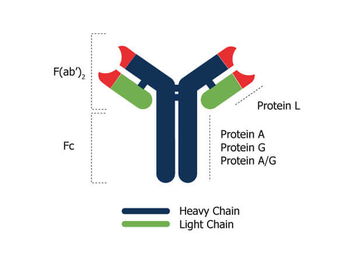
−| Purity | The product can be used for binding IgG from human, rabbit, goat, mouse and rat. It has strong binding of human, rabbit, cow, sheep, and goat polyclonal antibodies, mouse IgG2a, IgG2b, IgG3, and rat IgG2a. Protein A/G also has moderate affinity for mouse and rat IgG1 and IgG2c. It binds with weak affinity to rat IgG2b. Sepharose Protein A/G can be used for immunoprecipitation and purification of monoclonal antibodies. |
|---|---|
| Conjugation | Sepharose |
Storage & Handling
−| Storage | Store SEPHAROSE PROTEIN A/G at 4° C prior to opening. DO NOT FREEZE. |
|---|---|
| Form/Appearance | Suspension of agarose beads |
| Buffer/Preservatives | Buffer: 20% (v/v) Ethanol |
| Concentration | 0.5cc drained Sepharose per 2ml slurry |
| Expiration Date | 6 months from date of receipt. |
| Hazard Information | Non-Toxic |
| Disclaimer | For research use only |
Alternative Names
−Sepharose Protein A/G, Protein AG, agarose, ProA-ProG, Staphylococcus A protein, Sepharose Protein A, Streptococcus G protein, Sepharose Protein G, immunoprecipitation, IP western blot

Quality Guarantee
Explore bioreagents carefree to elevate your research. All our products are rigorously tested for performance. If a product does not perform as described on its datasheet, our scientific support team will provide expert troubleshooting, a prompt replacement, or a refund. For full details, please see our Terms & Conditions and Buying Guide. Contact us at [email protected].
Quick Database Links
UniProt
UniProt Details
− No UniProt data available
Protocol Information
WB
Western Blot (IB, immunoblot)
IP
Immunoprecipitation
Available Sizes
Select a size below
 Usually dispatched within 5-10 working days