
You have no items in your shopping cart.
p53 Signaling Pathway
The p53 signaling pathway is a central tumor suppressor mechanism in cells, often referred to as the "guardian of the genome." It plays a critical role in maintaining genomic stability, responding to stress, and preventing tumorigenesis.
Overview: p53 Signaling Pathway
The p53 signaling pathway is a central tumor suppressor mechanism in cells, often referred to as the "guardian of the genome." It plays a critical role in maintaining genomic stability, responding to stress, and preventing tumorigenesis.
The p53 signaling pathway governs cell fate decisions such as cell cycle arrest, apoptosis, senescence, and DNA repair. Nearly half of all human cancers harbor TP53 mutations or loss of p53 function, making it a prime target for cancer research and drug development.
p53 Protein and Functions
p53, encoded by the TP53 gene, is a transcription factor that senses DNA damage, oxidative stress, telomere shortening, and chromosomal abnormalities. It governs cell fate decisions such as cell cycle arrest, apoptosis, senescence, and DNA repair. Over 50% of human cancers harbor TP53 mutations or loss of p53 function, making it a prime target for cancer research and drug development.
Regulation and Activation of p53
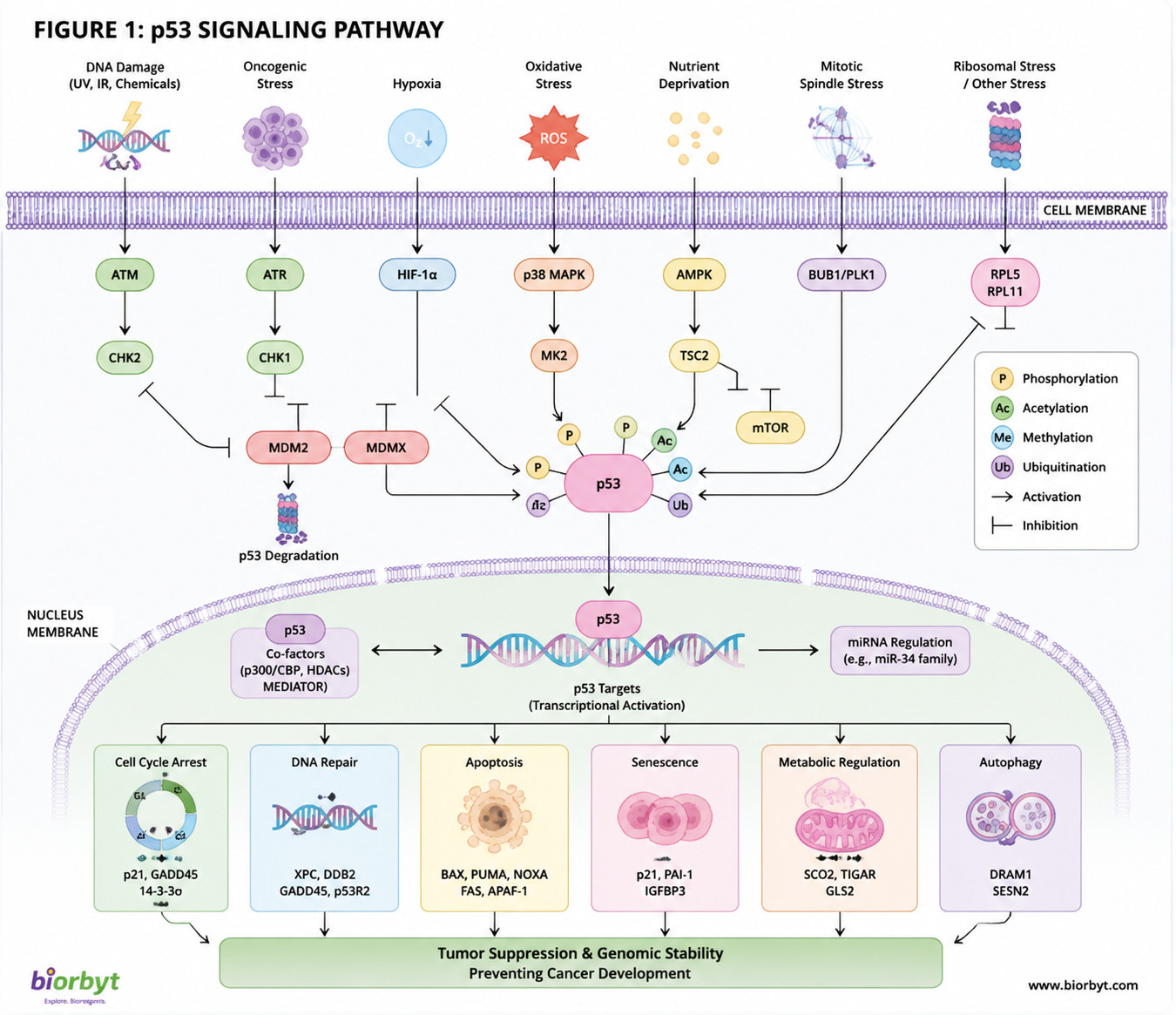
Under resting conditions, p53 is inhibited by MDM2 and maintained at low levels through ubiquitin-mediated degradation. Upon DNA damage or stress, kinases such as ATM, ATR, CHK1/CHK2, p38 MAPK, and AMPK phosphorylate p53, disrupting its interaction with MDM2, stabilizing p53, and enhancing its transcriptional activity. Post-translational modifications including phosphorylation, acetylation, methylation, and ubiquitination further modulate p53 activity to trigger downstream gene expression.
Downstream Targets and Functions
- Cell Cycle Arrest: Induces p21 (CDKN1A) to block G1/S phase progression, allowing DNA repair.
- Apoptosis: Upregulates BAX, PUMA, NOXA, and APAF-1 to activate intrinsic mitochondrial apoptosis, as well as FAS to stimulate the extrinsic apoptotic pathway.
- DNA Repair: Promotes repair via GADD45, XPC, and DDB2.
- Cellular Senescence: Controls p21 and PAI-1 to prevent uncontrolled proliferation of damaged cells.
- Metabolism & Antioxidant Response: Modulates SCO2, TIGAR, and GLS2.
- Autophagy: Regulates DRAM1 and SESN2 to maintain homeostasis and clear damaged organelles.
Physiological and Pathological Significance
p53 maintains genomic stability and cellular stress response. Its loss or mutation leads to uncontrolled cell proliferation, a key driver in many cancers. Activating or restoring p53 function is a major strategy in cancer therapy.
Research Products for p53 Pathway
Biorbyt offers antibodies, small molecule inhibitors, and ELISA kits targeting p53 and downstream genes such as p21 (CDKN1A), BAX, PUMA, MDM2, and GADD45. These products support protein expression analysis, phosphorylation studies, cell cycle, and apoptosis research.
Recommended p53 Research Products
Product Name | SKU | Applications |
|---|---|---|
Human p53 ELISA Kit | Sandwich ELISA | |
p53 (Phospho-S15) Antibody | IF, IHC, IP, WB | |
Phospho-CDKN1A/p21 (Thr145) Antibody (literature supported) | FC, IF, IHC-Fr, IHC-P | |
GADD45A / GADD45 Antibody | IF, IHC, IHC-P, WB | |
GADD45B Antibody | FC, IF, IHC-Fr, IHC-P, WB | |
Bax Rabbit Polyclonal Antibody (literature supported) | FC, ICC, IF, IHC-Fr, IHC-P, WB | |
PUMA Rabbit mAb | ICC, IF, IHC-Fr, IHC-P, WB | |
MDM2-p53-IN-1b | Small molecule inhibitor | |
Pifithrin-beta | p53 functional inhibitor |
🔬 All biorbyt products are rigorously validated to support precise and efficient research on the p53 signaling pathway in tumorigenesis and cellular stress response.
Quality & Validation Commitment
Biorbyt provides high-quality antibodies, small molecule inhibitors, and ELISA kits with extensive validation in flow cytometry, IHC, WB, IF, and other applications. Our products are citation-supported and backed by expert technical support to advance your p53 signaling research.
- ✔ Rigorously validated for specificity and reproducibility
- ✔ Target key nodes: p53, p21, BAX, PUMA, MDM2, GADD45
- ✔ Formats: antibodies, ELISA kits, small molecule modulators
- ✔ Trusted by researchers worldwide for cancer biology & stress signaling