
You have no items in your shopping cart.

Diagnostics & Therapeutics
Nanobodies in Therapeutics
Exploring the unique single-domain architecture of camelid-derived heavy chain antibodies and their growing applications in virology and oncology.
1. Biological Overview
In the 1990s, scientists discovered heavy chain antibodies in camelids, including camels, llamas, and alpacas. These antibodies differ from standard antibodies in their structure, as they are composed only of 2 heavy chains and a single variable antigen-binding domain (VHH). The VHH is of particular interest, as it retains its ability to bind to antigens even when it’s isolated. At 15kDa, these regions were termed “nanobodies” and are the smallest known naturally derived fragment with antigen binding capabilities.
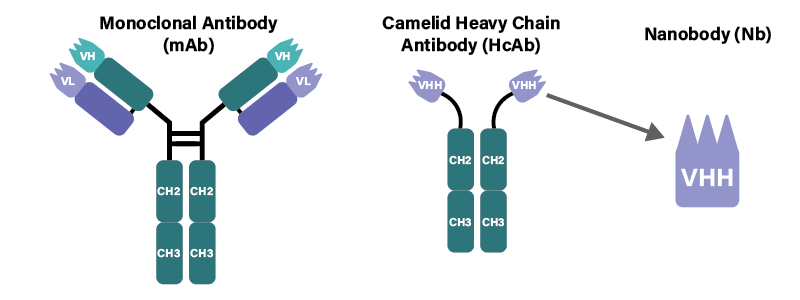
Structural comparison: Conventional antibody vs. Heavy-chain antibody vs. Nanobody (VHH domain).
2. Advantages of Nanobodies
Because of their unique structure, nanobodies offer numerous advantages over conventional monoclonal antibodies, making them a highly attractive focus for therapeutic and diagnostic research:
- High affinity and specificity for their targets.
- High solubility in aqueous environments.
- Ability to handle high temperature and pressure extremes.
- Ability to withstand a wide range of pH conditions.
- Ability to refold and recover function after chemical denaturation.
- Easy and inexpensive to produce in microbial expression systems.
3. Applications in COVID-19
With the outbreak of the pandemic in 2019, scientists have been researching and developing treatments for the virus. One significant area of study is the use of nanobodies as therapeutics.
When a person is infected with SARS-CoV-2, the viral S-glycoprotein binds to the ACE2 receptor of the host cell. Conformational changes result in the fusion of the virus with the cell membrane of the host cell. Nanobodies have been developed to target different stages of this process, disrupting the process and preventing the infection of host cells. In particular, nanobodies have been developed to block the spike protein from binding to the ACE2 receptor, break the bond between the spike protein and ACE2 receptor, and prevent the fusion of the membranes.
Nanobodies offer a number of advantages as a potential therapeutic for SARS-CoV-2. One of its greatest benefits is the ability to neutralize epitopes inaccessible to typical monoclonal antibodies. Nanobodies also have conformational adaptability, increasing their effectiveness by allowing them to adapt to the structure of their targets. In addition to the original SARS-CoV-2 virus, nanobodies have shown promising results in response to evolving variants of the virus.
4. Applications in Cancer
Nanobody research is being explored in two primary areas with regards to cancer: diagnostics and therapeutics.
Diagnostic Imaging
Compared to standard antibodies, nanobodies yield higher tumor-to-background ratios, providing clearer imaging identification of tumors. They have been utilized with molecular imaging techniques like PET and SPECT, as well as optical imaging like MRI and ultrasound. The most advanced targets currently include the human epidermal growth factor receptor 2 (HER2).
Therapeutic Penetration
Due to their small size, nanobodies can penetrate deeper into solid tumors than conventional antibodies. Furthermore, their hydrophilic nature results in low accumulation in non-target regions. Since 2007, nanobodies targeting EGFR, EGF, and HGF have been shown to delay tumor growth in vivo.
Researchers are also evaluating the pairing of nanobodies with other cancer therapeutics to increase efficacy. The penetration ability of nanobodies offers potential advantages to traditional T cell therapy, natural killer cell activation therapy, and dendritic cell vaccines, as lack of tissue penetration limits the efficacy of these treatments alone. Scientists are also studying the conjugation of nanobodies with cancer drugs to increase targeted anti-cancer activity.
5. References
- Bhattacharya M, Chatterjee S, Lee SS, Chakraborty C. Therapeutic applications of nanobodies against SARS-CoV-2 and other viral infections: Current update. Int J Biol Macromol. 2023 Feb 28;229:70-80. doi: 10.1016/j.ijbiomac.2022.12.284. Epub 2022 Dec 28. PMID: 36586649; PMCID: PMC9797221.
- Jumapili, N.A., Zivalj, M., Barthelmess, R.M., Raes, G., De Groof, T.W.M., Devoogdt, N., Stijlemans, B., Vincke, C. and Van Ginderachter, J.A. (2023), A few good reasons to use nanobodies for cancer treatment. Eur. J. Immunol., 53: 2250024. https://doi.org/10.1002/eji.202250024
- Minatel VM, Prudencio CR, Barraviera B and Ferreira RS Jr (2024) Nanobodies: a promising approach to treatment of viral diseases. Front. Immunol. 14:1303353. doi: 10.3389/fimmu.2023.1303353
- Yang EY and Shah K (2020) Nanobodies: Next Generation of Cancer Diagnostics and Therapeutics. Front. Oncol. 10:1182. doi: 10.3389/fonc.2020.01182