
You have no items in your shopping cart.
Description
Research Area
Epigenetics & Chromatin
Images & Validation
−Item 1 of 3
| Tested Applications | SDS-PAGE |
|---|---|
| Application Notes |
Key Properties
−| Source | Mouse |
|---|---|
| Biological Origin | Mouse |
| Isotype | IgG Fab |
| Conjugation | Unconjugated |
| Purity | Mouse IgG Fab fragment was prepared from normal serum by a multi-step process which includes delipidation, salt fractionation and ion exchange chromatography followed by papain digestion and extensive dialysis against the buffer stated above. Mouse IgG Fab fragment assayed by immunoelectrophoresis resulted in a single precipitin arc against anti-Mouse IgG, anti-Mouse IgG F(ab’)2 and anti-Mouse Serum. No reaction was observed against anti-Mouse IgG F(c) or anti- Papain. |
Storage & Handling
−| Storage | Store vial at 4° C prior to opening. This product is stable for several weeks at 4° C as an undiluted liquid. Dilute only prior to immediate use. For extended storage, aliquot contents and freeze at -20° C or below. Avoid cycles of freezing and thawing. |
|---|---|
| Form/Appearance | Liquid (sterile filtered) |
| Buffer/Preservatives | Preservative: 0.01% (w/v) Sodium Azide. Stabilizer: None; Buffer: 0.02 M Potassium Phosphate, 0.15 M Sodium Chloride, pH 7.2 |
| Concentration | 2.0 mg/mL |
| Expiration Date | 12 months from date of receipt. |
| Disclaimer | For research use only |
Alternative Names
−Mouse Immunoglobulin Fab, F(ab), Fragment antigen-binding
Similar Products
−

Quality Guarantee
Explore bioreagents carefree to elevate your research. All our products are rigorously tested for performance. If a product does not perform as described on its datasheet, our scientific support team will provide expert troubleshooting, a prompt replacement, or a refund. For full details, please see our Terms & Conditions and Buying Guide. Contact us at [email protected].
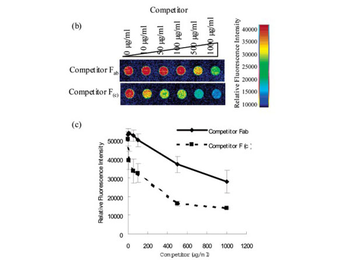
Ability of ProteoChip to bind the antibody F(c) region. (b) Scanning images of protein microarray: competition between FITC-labeled F(c) [p/n orb346285] and unlabeled Fab fragments [p/n orb346282] (upper picture), and FITC-labeled F(c) [p/n orb346285] and unlabeled F(c) fragments [orb346280] (lower picture). (c) Scanning images were analyzed using QuantumArray software, and fluorescence intensities of each spot were plotted versus competitor concentration. Competition between FITC-labeled F(c) and unlabeled Fab fragment, and FITC-labeled F(c) and unlabeled F(c) fragments, are shown by the solid line and broken line, respectively.
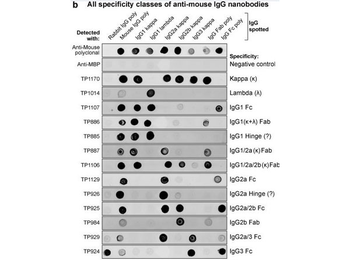
Characterization of the anti-IgG nanobody toolbox. (a) Overview of all identified anti-IgG nanobodies. The nanobodies obtained were characterized for IgG subclass and light chain specificity, epitope location on Fab or Fc fragment, and species cross reactivity. The protein sequences of all anti-IgG nanobodies can be found in Table S1. Nb, nanobody; CDR III, complementarity-determining region III; Gp, guinea pig; Hs, human; κ, κ light chain; λ, lambda light chain; Fab, fragment antigen-binding, Fc, fragment crystallizable. (a. not shown) (b) IgG subclass reactivity profiling of selected anti–mouse IgG nanobodies representing all identified specificity groups. The indicated IgG species were spotted on nitrocellulose strips, and the strips were blocked with 4% (wt/vol) milk in 1× PBS. Then 300 nM of the indicated tagged nanobodies were added in milk. After washing with 1× PBS, bound nanobodies were detected using a fluorescence scanner. Note that the signal strength on polyclonal IgG depends on the relative abundance of the specific subclass (e.g., IgG2b and IgG3 are low abundance) or light chain (κ/λ ratio = 99:1). TP885 and TP926 showed no detectable binding to polyclonal Fab or Fc fragment and might bind to the hinge region. (p/n orb343762 Mouse IgG1 λ lambda, orb346282 Mouse Fab fragment).
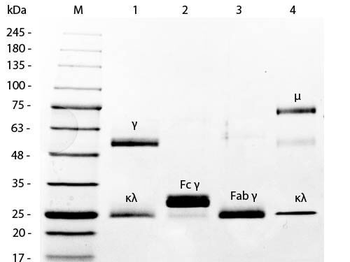
SDS-PAGE of Mouse IgG Whole Molecule Rhodamine Conjugated (p/n orb346272). MW: 5 µl Opal Prestained Marker. Lane 1: Reduced Mouse IgG Whole Molecule Rhodamine Conjugated (p/n orb346272). Lane 2: Reduced Mouse F(c) Fragment (p/n orb346280). Lane 3: Reduced Mouse F(ab) Fragment (p/n orb346282). Lane 4: Mouse IgM Kappa Myeloma Protein. Load: 1 µg per lane. Predicted/Observed size: IgG at 50 and 25 kDa; F(c) at 25 kDa; F(ab) at 25 kDa; IgM K at 70 and 23 kDa. Observed F(c) Fragment migrates slightly higher.
Documents Download
Datasheet
Product Information
Request a Document
Protocol Information
Protein Handling and Storage Guide
Protein Handling Guide
SDS-PAGE
Sodium Dodecyl Sulphate PolyAcrylamide Gel Electrophoresis
Mouse IgG Fab fragment Antibody (orb346282)

- 0.0
Based on 0 reviews
Participating in our Biorbyt product reviews program enables you to support fellow scientists by sharing your firsthand experience with our products.
Login to Submit a ReviewAvailable Sizes
Select a size below
 Usually dispatched within 5-10 working days