
You have no items in your shopping cart.
Hantavirus Research Hub
Advanced reagents for Orthohantavirus tracking, structural analysis, and diagnostic development. Explore highly validated antibodies, recombinant glycoproteins, and molecular tools.
Emerging Orthohantaviruses
As the global research community focuses on proactive pandemic preparedness, assessing the threat of emerging zoonotic pathogens is paramount. With the recent 2026 outbreak of the Andes virus drawing acute attention to the risks of respiratory spillover, the silent circulation of these pathogens necessitates rapid identification methodologies.
Biorbyt provides a comprehensive portfolio of high-precision tools designed to build the foundational knowledge required for rapid detection, viral characterization, and therapeutic intervention during future outbreaks.
HPS vs. HFRS: Why Diagnostic Research Matters
Hantaviruses manifest in two primary, geographically distinct clinical forms:
- Hantavirus Pulmonary Syndrome (HPS): Prevalent in the Americas (e.g., Andes virus, Sin Nombre virus), this syndrome is characterized by rapid-onset respiratory failure and carries a high mortality rate.
- Hemorrhagic Fever with Renal Syndrome (HFRS): Endemic to Europe and Asia (e.g., Puumala virus, Hantaan virus), typically presenting with renal complications, hemorrhage, and fever.
The Diagnostic Challenge: The early symptoms of HPS heavily overlap with other respiratory distress illnesses, including COVID-19 and severe influenza (presenting as fever and myalgia). This overlap makes high-quality, highly specific diagnostic reagents a critical priority for public health laboratories to prevent dangerous misdiagnoses.
Viral Structure, Targets & Lectin Biology
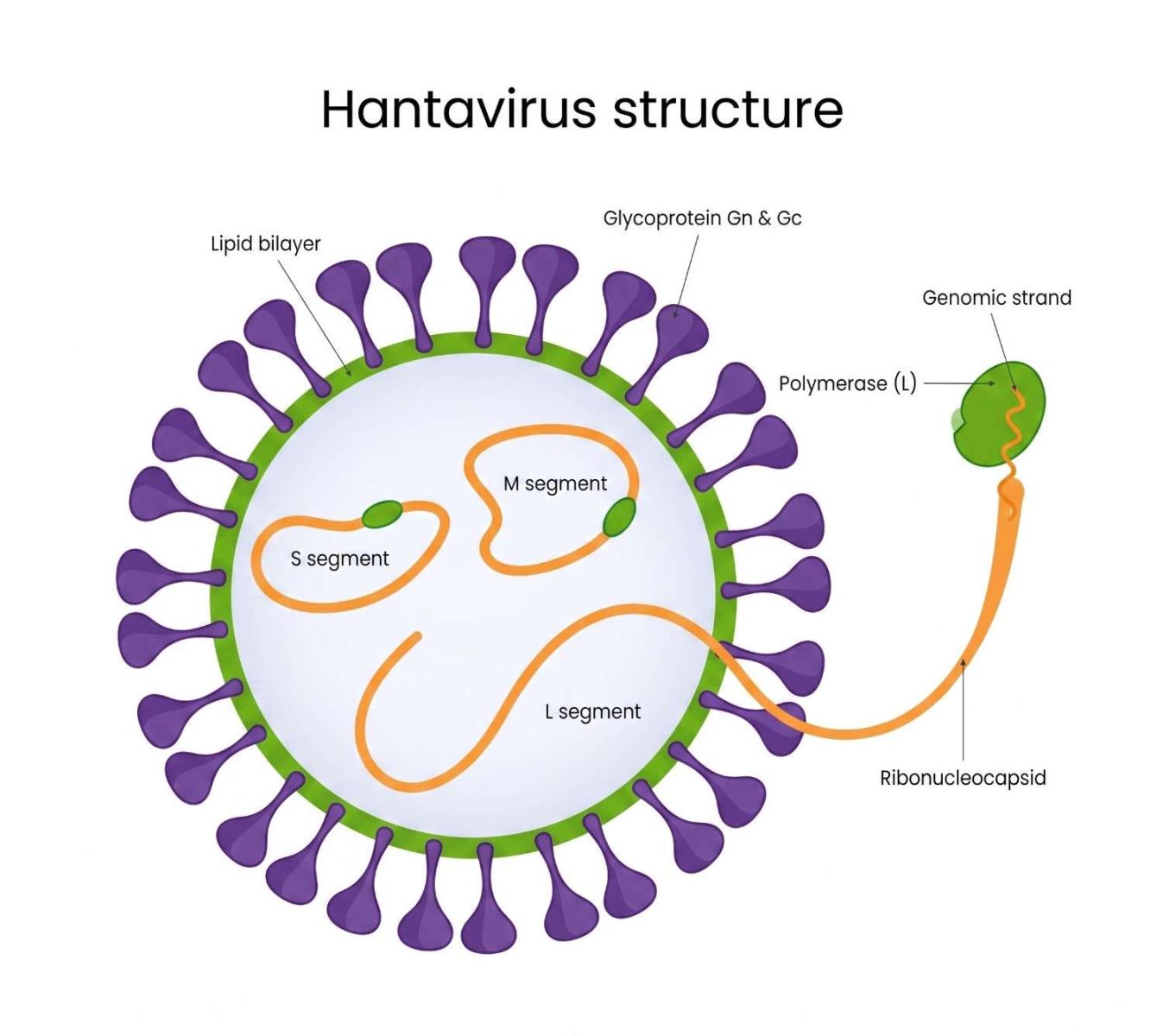
Hantaviruses are enveloped, negative-sense, single-stranded RNA viruses containing a distinct three-segment genome. The encoded Nucleocapsid (NP) and Glycoprotein (Gn/Gc) complexes are pivotal research targets, as they directly mediate viral adhesion, entry, and immune evasion. Minor structural differences across these proteins enable the specific detection and subtyping of viral strains.
Crucially, the hantavirus envelope is heavily glycosylated, making it a key area for research into therapeutic inhibition and vaccine development. Research indicates that specific lectins interact dynamically with these viral surface glycans. For example, certain lectins like DBA and SBA have been shown to mediate viral infection, whereas others, such as griffithsin, exhibit potent inhibitory effects by blocking viral entry.
Hantaan Virus (HTNV) Products
Product Name | Type | SKU |
|---|---|---|
Monoclonal Antibody | ||
Antibody | ||
Antibody | ||
Polyclonal Antibody | ||
Recombinant Protein | ||
Recombinant Protein | ||
ELISA Kit | ||
ELISA Kit | ||
ELISA Kit |
Andes Virus (ANDV) Products
Product Name | Type | SKU |
|---|---|---|
Antibody | ||
Antibody | ||
Peptide | ||
Peptide |
Puumala Virus (PUUV) Products
Product Name | Type | SKU |
|---|---|---|
Orthohantavirus puumalaense Glycoprotein C/Gc Polyclonal Antibody | Polyclonal Antibody | |
Orthohantavirus puumalaense GP/Envelopment polyprotein Human Monoclonal Antibody | Monoclonal Antibody | |
Antibody | ||
Antibody | ||
Recombinant Protein | ||
Recombinant Protein |
Seoul Virus (SEOV) Products
Product Name | Type | SKU |
|---|---|---|
Recombinant Protein | ||
Recombinant Seoul virus Envelopment polyprotein (GP), partial | Recombinant Protein |
Sin Nombre Virus (SNV) Products
Product Name | Type | SKU |
|---|---|---|
Antibody | ||
Polyclonal Antibody | ||
Antibody | ||
Peptide |
Black Creek Canal (BCCV) Products
Product Name | Type | SKU |
|---|---|---|
Polyclonal Antibody | ||
Recombinant Protein | ||
Recombinant Protein |
Advanced & Specialized Reagents
Host Cell Receptors: Integrin αVβ3
Pathogenic hantaviruses that cause HPS and HFRS utilize host integrins—specifically Integrin αVβ3—to mediate cell entry via the Gn/Gc glycoprotein complex. Studying these heterodimers is essential for understanding viral pathogenesis and testing entry inhibitors.
Product Name | Category | Applications | SKU |
|---|---|---|---|
Recombinant Protein |
MALS-Verified Human Monoclonal Antibodies
Multi-Angle Light Scattering (MALS) verified antibodies ensure ultra-high purity, correct oligomeric state, and precise structural integrity—ideal for critical neutralization assays and structural virology.
Product Name | Target | Applications | SKU |
|---|---|---|---|
HTNV pre-Gc | |||
Hantaan Virus Gc Broad-Neutralizing Human Monoclonal Antibody | HTNV Gc |
Validation Tools: Blocking Peptides
For researchers conducting immunohistochemistry (IHC) or complex Western Blots, proving antibody specificity is mandatory. Our synthetic blocking peptides allow you to pre-incubate and neutralize the primary antibody to confirm the absence of off-target binding.
Product Name | Target Strain | SKU |
|---|---|---|
Andes Virus (ANDV) | ||
Andes Virus (ANDV) | ||
Puumala Virus (PUUV) | ||
Sin Nombre Virus (SNV) |
Pre-Conjugated Primary Antibodies
Reduce assay time and minimize background noise by utilizing primary antibodies pre-conjugated to reporting enzymes or fluorophores.
Product Name | Conjugate Options | SKU |
|---|---|---|
Bibliography
- European Centre for Disease Prevention and Control (ECDC). Andes hantavirus outbreak in cruise ship, 19 May 2026 – Outbreak update. ECDC website. 2026.
- World Health Organization (WHO). Andes hantavirus outbreak – Situation summary. WHO Hantavirus Bulletins. 2026.
- U.S. Centers for Disease Control and Prevention (CDC). Hantavirus Outbreak – 2026: Testing for Potential Infection (HAN 00529). HAN Notices. 2026.
- Department of Health and Social Care (UK). Outbreaks under monitoring – Week 19 (week ending 10 May 2026). UKHSA/GOV.UK. 2026.
- U.S. Centers for Disease Control and Prevention. Clinician Brief: Hemorrhagic Fever with Renal Syndrome (HFRS). CDC website, 2023–2026 update.
- Tortosa F. et al. Prognostic factors for mortality in patients infected with New World hantaviruses: a systematic review and meta-analysis BMJ Open. 2026;
- Hepojoki J, et al. Hantaviral proteins: structure, functions, and role in hantavirus pathogenesis. Front Microbiol. 2015;6:1326. https://doi.org/10.3389/fmicb.2015.01326
- Poissonnier S, et al. Mechanistic insight into bunyavirus‑induced membrane fusion from structural studies. PLoS Pathog. 2016;12(10):e1005813. https://doi.org/10.1371/journal.ppat.1005813
- Moulaei T, et al. Griffithsin‑mediated inhibition of cellular entry of hemorrhagic fever viruses and insights into its mechanisms. Antiviral Res. 2026;139:105432. https://pubmed.ncbi.nlm.nih.gov/42037406/
- Mori T, et al. Griffithsin protects mice from genital herpes by preventing cell‑to‑cell spread. J Virol. 2013;87(14):7945–7955. https://doi.org/10.1128/JVI.00012-13
- BMJ. Hantavirus: What you need to know. BMJ. 2026;393:s877. https://doi.org/10.1136/bmj.s877
- Virological.org. Complete sequence of Orthohantavirus andesense virus: Swiss resident 2026. Virological, 2026.