
You have no items in your shopping cart.
Virology & Emerging Pathogens
Decoding the Nipah Virus: Pathogenesis, Immune Evasion & Therapeutics
Investigating the mechanisms behind a 40–75% fatality rate and tracking the latest breakthroughs in global vaccines and antiviral treatments.
Recently, a localized Nipah virus outbreak in West Bengal, India, rapidly escalated into a global public health concern. According to official reports ending January 26, 2026, the region recorded confirmed cases including nurses, doctors, and healthcare workers—indicating a clear chain of human-to-human transmission within medical institutions.
Extreme Fatality Rate
The high alert surrounding the Nipah virus outbreak stems from a case fatality rate between 40% and 75%. Compared to SARS-CoV-2 (where Omicron post-vaccination sits below 0.1%), the Nipah virus fatality rate exceeds COVID-19 by over 100 times.
1. Why is the Nipah Virus so Deadly?
The Nipah virus is not a novel pathogen. It belongs to the Henipavirus genus, representing a zoonotic virus with pandemic potential and high lethality. Its natural reservoirs are fruit bats (flying foxes, Pteropodidae).
Transmission to humans occurs through intermediate hosts (such as pigs) or direct consumption of bat-contaminated food (like raw date palm sap). Infection causes severe acute respiratory syndrome and encephalitis. Crucially, limited but definitive human-to-human transmission has been confirmed in close-contact environments, particularly households and healthcare facilities.
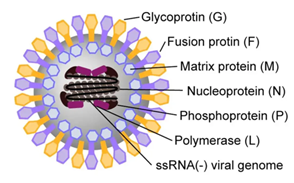
Figure 1: Morphological structure of Henipaviruses.
2. Mechanisms of Invasion & Immune Evasion
The virus achieves systemic infection by utilizing the Ephrin-B2/B3 proteins as its entry receptor. Because these proteins are widely expressed on vascular endothelial cells and central nervous system neurons, infection rapidly triggers systemic vasculitis and encephalitis.
More critically, the Nipah virus systematically suppresses the host's innate immune defenses—particularly the interferon (IFN) system—creating a "stealth" environment conducive to massive viral replication. The virus encodes six major structural and accessory proteins that orchestrate this evasion:
V Protein
Binds directly to host viral sensors MDA5 and LGP2. Inhibits PP1α/γ phosphatases, preventing MDA5 activation. Modulates STAT1 affinity to attenuate STAT1/2-mediated signaling.
W Protein
Localizes to the nucleus to accumulate 14-3-3 proteins, sequestering NF-κB subunits. Blocks TBK1/IKKε-mediated IRF3 dimerization, inhibiting IFN-I induction.
C Protein
Implicated in broadly inhibiting early antiviral IFN responses and suppressing the production of localized pro-inflammatory cytokines.
M & F Proteins
M Protein: Targets the E3 ubiquitin ligase TRIM6 for degradation, impairing IRF3 phosphorylation.
F Protein: Shields viral epitopes with N-linked glycans to hinder antibody recognition.
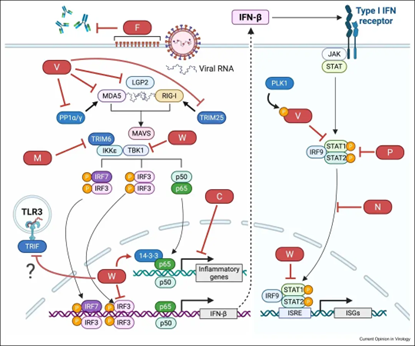
Figure 2: Evasion of Innate Immune Signaling Cascades Mediated by Henipaviruses.
3. Therapeutic & Vaccine Breakthroughs
The global health community's response to the Nipah virus requires "scientific vigilance, not panic." While no specific therapeutics or vaccines are officially approved, significant progress has been made recently:
- Antiviral Drug VV116: Research published in Emerging Microbes & Infections (Nov 2025) demonstrated that VV116, an oral nucleoside analog previously approved for COVID-19, potently inhibits the Nipah virus. In animal models, it reduced lung damage and increased survival rates to 66.7%.
- LN1F9 Monoclonal Antibody: A study in npj Vaccines (Nov 2025) identified LN1F9 as a standout antibody. Targeting the NiV G protein, it provided 100% protection in animal models by directly blocking the virus from binding to the ephrin-B2 receptor.
- ChAdOx1 NipahB Vaccine: According to CEPI, the University of Oxford initiated the world's first Phase II clinical trial for a Nipah virus vaccine in Bangladesh (December 2025), evaluating safety and immunogenicity in a high-risk population.
4. Biorbyt Nipah Virus Research Tools
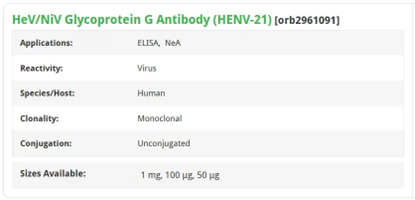
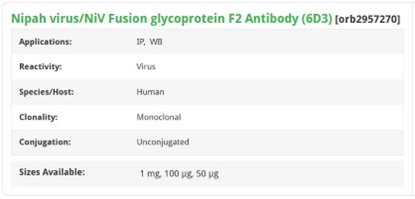
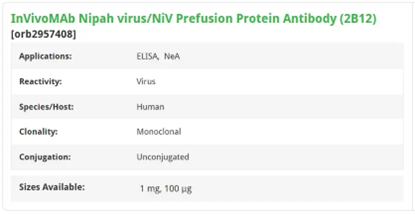
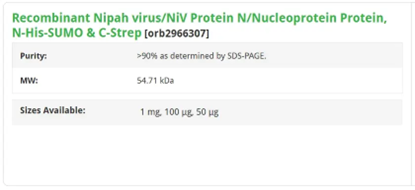
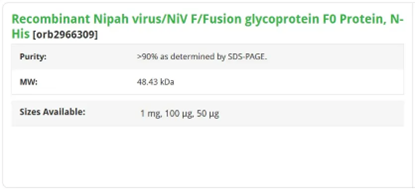
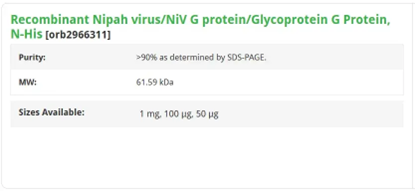
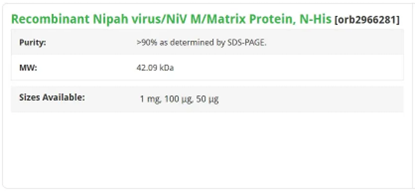
The rapid development of the aforementioned drugs and vaccines relies heavily on high-quality laboratory reagents. Biorbyt offers a comprehensive suite of Nipah virus recombinant proteins and monoclonal antibodies to support your virology research:
5. References
- Kim J, Lee SJ, Ahn DG, Yoo JS. Immune evasion and pathogenesis of henipaviruses. Curr Opin Virol. 2026 Jan 21;74:101509. doi: 10.1016/j.coviro.2026.101509. Epub ahead of print. PMID: 41570456.
- Zhang Y, Yao Y, Song S, Gao G, Peng Y, Liu H, Chen M, Zheng W, Tian G, Xie Y, Shen J, Xiao G, Hu T, Shan C, Zhang L. The oral nucleoside drug VV116 is a promising candidate for treating Nipah virus infection. Emerg Microbes Infect. 2025 Dec;14(1):2587983. doi: 10.1080/22221751.2025.2587983. Epub 2025 Nov 19. PMID: 41257471; PMCID: PMC12632212.
- Zhou D, Wang Y, Yao Y, Kuang W, Cheng R, Zhang G, Liu H, Li X, Chiu S, Deng Z, Zhao H. Antigenic landscape of Nipah virus attachment glycoprotein analysis reveals a protective immunodominant epitope across species. NPJ Vaccines. 2025 Nov 28;11(1):5. doi: 10.1038/s41541-025-01319-2. PMID: 41315143; PMCID: PMC12780214.
- CEPI. University of Oxford launches world's first Phase II Nipah virus vaccine trial. https://cepi.net/university-oxford-launches-worlds-first-phase-ii-nipah-virus-vaccine-trial