Cart summary

You have no items in your shopping cart.

DYKDDDDK Tag (FLAG) Antibody

SKU: orb345396

Description

Detection of FLAG proteins antibody

Images & Validation

Tested ApplicationsELISA, WB
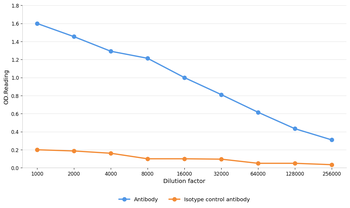
Dilution rangeELISA: 1:20,000 - 1:40,000, WB: 1:2,000 - 1:10,000
Application Notes
This antibody is optimally suited for monitoring the expression of FLAG tagged fusion proteins. As such, this antibody can be used to identify fusion proteins containing the FLAG epitope. The antibody recognizes the epitope tag fused to either the amino- or carboxy- termini of targeted proteins. This antibody has been tested by ELISA and western blotting against both the immunizing peptide and FLAGä containing recombinant proteins. Although not tested, this antibody is likely functional for immunoprecipitation, immunocytochemistry, and other immunodetection techniques. The epitope tag peptide sequence was first derived from the 11-amino-acid leader peptide of the gene-10 product from bacteriophage T7. Now the most commonly used hydrophilic octapeptide is DYKDDDDK. Biorbyt's polyclonal antibody to detect FLAG conjugated proteins binds FLAG containing fusion proteins with greater affinity than the widely used monoclonal M1, M2 and M5 clones, and shows greater sensitivity in most assays. Affinity purification of the polyclonal antibody results in very low background levels in assays and low cross-reactivity with other cellular proteins.

Key Properties

Antibody TypePrimary Antibody
HostRabbit
ClonalityPolyclonal
IsotypeIgG
ImmunogenThis antibody was purified from whole rabbit serum prepared by repeated immunizations with the Enterokinase Cleavage Site (ECS) peptide DYKDDDDK (Asp-Tyr-Lys-Asp-Asp-Asp-Asp-Lys) conjugated to KLH using maleimide. This antibody reacts with FLAG conjugated proteins.
PurityThis affinity purified antibody is directed against the FLAG motif and is useful in determining its presence in various assays. This polyclonal anti-FLAG tag antibody detects over-expressed proteins containing the FLAG epitope tag. In western blotting of bacterial extracts, the antibody does not cross-react with endogenous proteins.
ConjugationUnconjugated

Storage & Handling

StorageStore vial at -20° C prior to opening. Aliquot contents and freeze at -20° C or below for extended storage. Avoid cycles of freezing and thawing. Centrifuge product if not completely clear after standing at room temperature. This product is stable for several weeks at 4° C as an undiluted liquid. Dilute only prior to immediate use.
Form/AppearanceLiquid (sterile filtered)
Buffer/Preservatives0.01% (w/v) Sodium Azide
Concentration1.09
Dry Ice ShippingPlease note: This product requires shipment on dry ice. A dry ice surcharge will apply.
DisclaimerFor research use only

Alternative Names

rabbit antibody for the detection of FLAG conjugated proteins, rabbit anti DYKDDDDK

Similar Products

  • DYKDDDDK Tag (FLAG) Antibody [orb345397]

    ELISA,  WB

    Rabbit

    Polyclonal

    Unconjugated

    25 μl
  • Anti-DDDDK-tag [M2.1] [orb396135]

    ELISA,  IF,  WB

    Mouse

    Monoclonal

    Unconjugated

    0.2 mg
  • Anti-DDDDK-tag [M2.1] [orb396143]

    ELISA,  IF,  WB

    Mouse

    Monoclonal

    Unconjugated

    0.2 mg
  • Flag Tag Recombinant Mouse Monoclonal Antibody [orb526695]

    ELISA,  WB

    All

    Mouse

    Recombinant

    Unconjugated

    500 μl, 100 μl, 1000 μl, 200 μl
  • FLAG Tag (CT) Rabbit Polyclonal Antibody [orb612171]

    ELISA,  WB

    All

    Rabbit

    Polyclonal

    Unconjugated

    100 μl, 1000 μl, 500 μl, 200 μl
Quality Guarantee

Quality Guarantee

Explore bioreagents carefree to elevate your research. All our products are rigorously tested for performance. If a product does not perform as described on its datasheet, our scientific support team will provide expert troubleshooting, a prompt replacement, or a refund. For full details, please see our Terms & Conditions and Buying Guide. Contact us at [email protected].

DYKDDDDK Tag (FLAG) Antibody

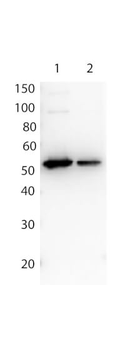
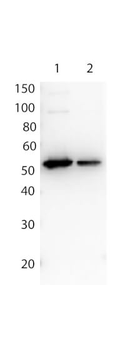
Affinity Purified Antibody to detect FLAG conjugated proteins detects both C terminal linked and N terminal linked FLAG tagged recombinant proteins by western blot. This antibody was used at a dilution of 1:1000 to detect 0.1 µg of recombinant protein containing either the FLAG epitope tag linked at the carboxy (C), Lane 2, or the amino (N), Lane 1, terminus of the recombinant protein. A 4-20% gradient gel was used to resolve the protein by SDS-PAGE. The protein was transferred to nitrocellulose using standard methods. After blocking, the membrane was probed with the primary antibody overnight at 4°C followed by washes and reaction with a 1:40000 dilution of HRP conjugated Gt-a-Rabbit IgG (H&L) MX10 (code orb347654) for 30 min at room temperature.

DYKDDDDK Tag (FLAG) Antibody

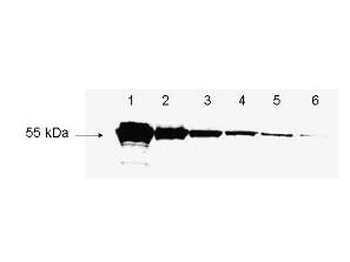
Biorbyt's antibody to detect FLAG™ conjugated proteins is shown to detect as little as 3 ng of amino-terminal FLAG™ tagged recombinant protein by western blot. This antibody was used at a 1:1000 dilution to detect 3-fold serial dilutions of amino-terminal FLAG™-Bacterial Alkaline Phosphatase (BAP) fusion protein (Sigma P-7582) starting at 1.0 µg of protein as shown in lanes 1-6 respectively. A 4-20% gradient gel was used to separate the protein by SDS-PAGE. The protein was transferred to nitrocellulose using standard methods. After blocking, the membrane was probed with the primary antibody for 1 h at room temperature followed by washes and reaction with a 1:10000 dilution of IRDye® 800 conjugated Gt-a-Rabbit IgG (H&L) for 30 min at room temperature.

DYKDDDDK Tag (FLAG) Antibody

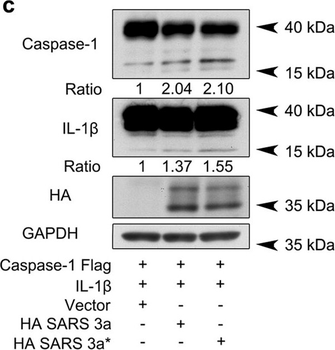
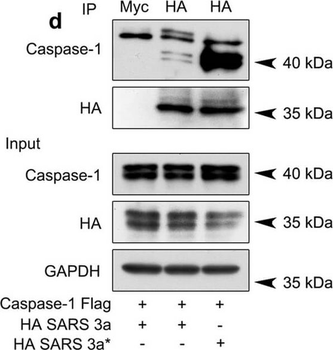
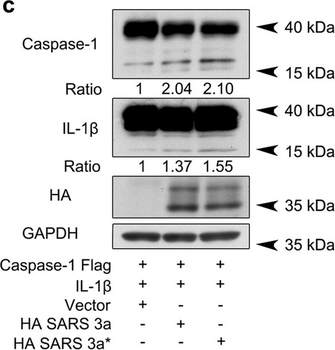
SARS 3a induces NLRP3 inflammasome activation by multiple mechanisms. A) Immunoblot analysis of the pro- and cleaved forms of caspase-1 and IL-1β after reconstitution of inflammasome in HEK 293T cells transfected with SARS 3a with or without NEK7 shRNA. B) Immunoblot analysis of the pro- and cleaved forms of caspase-1 and IL-1β after reconstitution of inflammasome and transfection with SARS 3a or SARS 3a C133A. C) Immunoblot analysis of the pro- and cleaved forms of caspase-1 and IL-1β after co-transfection with caspase-1, IL-1β, and SARS 3a or SARS 3a C133A. D) Immunoprecipitation analysis of interaction between SARS 3a or SARS 3a C133A and caspase-1. All western blot data are representative of two or three independent experiments.

DYKDDDDK Tag (FLAG) Antibody

SARS 3a induces NLRP3 inflammasome activation by multiple mechanisms. A) Immunoblot analysis of the pro- and cleaved forms of caspase-1 and IL-1β after reconstitution of inflammasome in HEK 293T cells transfected with SARS 3a with or without NEK7 shRNA. B) Immunoblot analysis of the pro- and cleaved forms of caspase-1 and IL-1β after reconstitution of inflammasome and transfection with SARS 3a or SARS 3a C133A. C) Immunoblot analysis of the pro- and cleaved forms of caspase-1 and IL-1β after co-transfection with caspase-1, IL-1β, and SARS 3a or SARS 3a C133A. D) Immunoprecipitation analysis of interaction between SARS 3a or SARS 3a C133A and caspase-1. All western blot data are representative of two or three independent experiments.

DYKDDDDK Tag (FLAG) Antibody

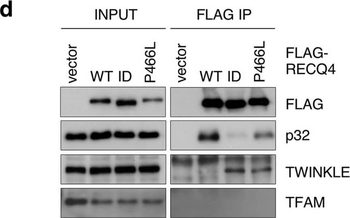
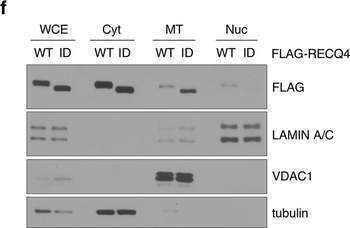
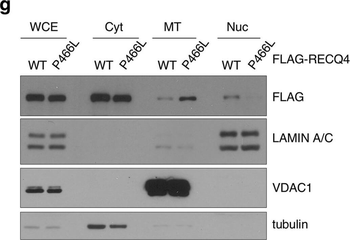
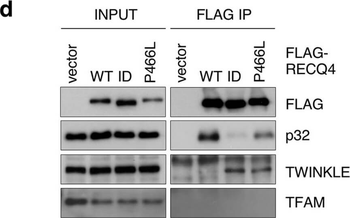
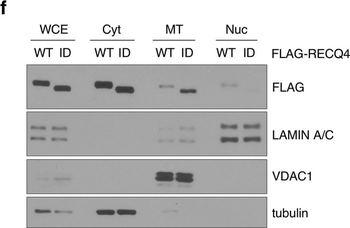
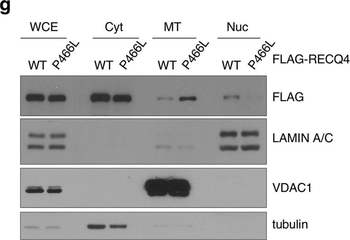
The P466L clinical mutation leads to RECQ4 mitochondrial accumulation. (a) Schematic of human RECQ4 WT, ID and P466L mutant proteins, including the SLD2 (green) and conserved SF2 helicase domains (yellow). (b) Western blot analysis of RECQ4 in WCEs and chromatin-bound (CB) fractions prepared from HEK293 WT or RECQ4 knockdown (KD) HEK293 cells generated by CRISPR technology. Tubulin is used as a loading control. (c) The effects of stable RECQ4 KD shown in (b) and complementation using FLAG-RECQ4 on cell growth as measured by crystal violet cell proliferation assays. Each value represents mean ± standard deviation of 3 independent biological experiments, each with 3 triplicate reactions. (d) Western blot analysis for the presence of WT and mutant FLAG-RECQ4, p32, TWINKLE and TFAM in WCE (left) and immunoprecipitated (IP) with FLAG-RECQ4 complexes (right) in WCEs prepared from stable RECQ4 KD HEK293 cells expressing FLAG-RECQ4 WT, ID or P466L mutant. (e) gDNA levels relative to mtDNA in WCE (left) and MT (right) prepared from stable RECQ4 KD HEK293 cells expressing FLAG-RECQ4 WT, ID or P466L mutant. (f) Western blot analysis of stable RECQ4 KD HEK293 cells expressing FLAG-RECQ4 WT or ID mutant in WCEs and Cyt, MT, and fractions. Tubulin, VDAC1, and lamin A/C are loading and fractionation controls for Cyt, MT, and Nuc fractions, respectively. (g) Western blot analysis of RECQ4 in WCEs and Cyt, MT, and Nuc fractions prepared from stable RECQ4 KD HEK293 cells expressing FLAG-RECQ4 WT or P466L mutant. (h) Representative images showing immunofluorescent staining of FLAG-RECQ4 (green) in stable RECQ4 KD HEK293 cells expressing indicated WT and mutant FLAG-RECQ4 proteins. Mitotracker (red) was used to detect mitochondria, and DAPI (blue) was used to detect nuclei.

DYKDDDDK Tag (FLAG) Antibody

The P466L clinical mutation leads to RECQ4 mitochondrial accumulation. (a) Schematic of human RECQ4 WT, ID and P466L mutant proteins, including the SLD2 (green) and conserved SF2 helicase domains (yellow). (b) Western blot analysis of RECQ4 in WCEs and chromatin-bound (CB) fractions prepared from HEK293 WT or RECQ4 knockdown (KD) HEK293 cells generated by CRISPR technology. Tubulin is used as a loading control. (c) The effects of stable RECQ4 KD shown in (b) and complementation using FLAG-RECQ4 on cell growth as measured by crystal violet cell proliferation assays. Each value represents mean ± standard deviation of 3 independent biological experiments, each with 3 triplicate reactions. (d) Western blot analysis for the presence of WT and mutant FLAG-RECQ4, p32, TWINKLE and TFAM in WCE (left) and immunoprecipitated (IP) with FLAG-RECQ4 complexes (right) in WCEs prepared from stable RECQ4 KD HEK293 cells expressing FLAG-RECQ4 WT, ID or P466L mutant. (e) gDNA levels relative to mtDNA in WCE (left) and MT (right) prepared from stable RECQ4 KD HEK293 cells expressing FLAG-RECQ4 WT, ID or P466L mutant. (f) Western blot analysis of stable RECQ4 KD HEK293 cells expressing FLAG-RECQ4 WT or ID mutant in WCEs and Cyt, MT, and fractions. Tubulin, VDAC1, and lamin A/C are loading and fractionation controls for Cyt, MT, and Nuc fractions, respectively. (g) Western blot analysis of RECQ4 in WCEs and Cyt, MT, and Nuc fractions prepared from stable RECQ4 KD HEK293 cells expressing FLAG-RECQ4 WT or P466L mutant. (h) Representative images showing immunofluorescent staining of FLAG-RECQ4 (green) in stable RECQ4 KD HEK293 cells expressing indicated WT and mutant FLAG-RECQ4 proteins. Mitotracker (red) was used to detect mitochondria, and DAPI (blue) was used to detect nuclei.

DYKDDDDK Tag (FLAG) Antibody

The P466L clinical mutation leads to RECQ4 mitochondrial accumulation. (a) Schematic of human RECQ4 WT, ID and P466L mutant proteins, including the SLD2 (green) and conserved SF2 helicase domains (yellow). (b) Western blot analysis of RECQ4 in WCEs and chromatin-bound (CB) fractions prepared from HEK293 WT or RECQ4 knockdown (KD) HEK293 cells generated by CRISPR technology. Tubulin is used as a loading control. (c) The effects of stable RECQ4 KD shown in (b) and complementation using FLAG-RECQ4 on cell growth as measured by crystal violet cell proliferation assays. Each value represents mean ± standard deviation of 3 independent biological experiments, each with 3 triplicate reactions. (d) Western blot analysis for the presence of WT and mutant FLAG-RECQ4, p32, TWINKLE and TFAM in WCE (left) and immunoprecipitated (IP) with FLAG-RECQ4 complexes (right) in WCEs prepared from stable RECQ4 KD HEK293 cells expressing FLAG-RECQ4 WT, ID or P466L mutant. (e) gDNA levels relative to mtDNA in WCE (left) and MT (right) prepared from stable RECQ4 KD HEK293 cells expressing FLAG-RECQ4 WT, ID or P466L mutant. (f) Western blot analysis of stable RECQ4 KD HEK293 cells expressing FLAG-RECQ4 WT or ID mutant in WCEs and Cyt, MT, and fractions. Tubulin, VDAC1, and lamin A/C are loading and fractionation controls for Cyt, MT, and Nuc fractions, respectively. (g) Western blot analysis of RECQ4 in WCEs and Cyt, MT, and Nuc fractions prepared from stable RECQ4 KD HEK293 cells expressing FLAG-RECQ4 WT or P466L mutant. (h) Representative images showing immunofluorescent staining of FLAG-RECQ4 (green) in stable RECQ4 KD HEK293 cells expressing indicated WT and mutant FLAG-RECQ4 proteins. Mitotracker (red) was used to detect mitochondria, and DAPI (blue) was used to detect nuclei.

DYKDDDDK Tag (FLAG) Antibody

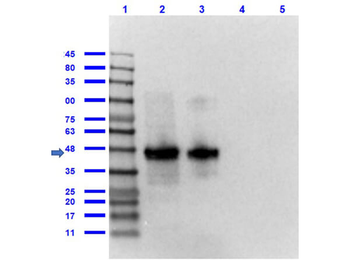
Western Blot of Rabbit anti-FLAG antibody. Lane 1: Opal Prestained Molecular Weight Marker. Lane 2: FLAG Positive Control Lysate (p/n orb535116) (10 µg) [+]. Lane 3: 12 Epitope GST Tagged Lysate (p/n orb535115) (10 µg) [+]. Lane 4: rGST protein (p/n orb345956) (0.1 µg) [-]. Lane 5: MBP protein (0.1 µg) [-]. Primary Antibody: Anti-FLAG at 1.0 µg/ml overnight at 2-8°C. Secondary Antibody: Goat Anti-Rabbit IgG Peroxidase (p/n orb347654) at 1:70000 at RT for 30 mins. Block: BlockOut Buffer (p/n orb348644). Predicted MW: ~55kDa. Observed MW: ~48kDa. Exposure: 2 sec.

DYKDDDDK Tag (FLAG) Antibody

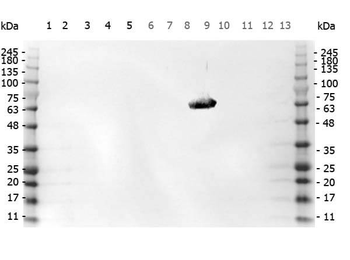
Western Blot of Rabbit anti-FLAG antibody. Marker: Opal Pre-stained ladder. Lane 1: HEK293 lysate (p/n orb348669). Lane 2: HeLa Lysate (p/n orb348668). Lane 3: CHO/K1 Lysate. Lane 4: MDA-MB-231 (p/n orb348700). Lane 5: A431 Lysate (p/n orb348665). Lane 6: Jurkat Lysate (p/n orb348674). Lane 7: NIH/3T3 Lysate (p/n orb348714). Lane 8: E-coli HCP Control (p/n orb342262). Lane 9: FLAG Positive Control Lysate (p/n orb348661). Lane 10: Red Fluorescent Protein (p/n orb345960). Lane 11: Green Fluorescent Protein (p/n orb345957). Lane 12: Glutathione-S-Transferase Protein. Lane 13: Maltose Binding Protein. Load: 10 µg of lysate or 50 ng of purified protein per lane. Primary antibody: FLAG antibody at 1 ug/ml overnight at 4C. Secondary antibody: Peroxidase rabbit secondary antibody (p/n orb347654) at 1:30000 for 60 min at RT. Blocking Buffer: 1% Casein-TTBS for 30 min at RT. Predicted/Observed size: 55 kDa for FLAG.

Documents Download

Datasheet
Product Information
Download

Request a Document

Protocol Information

WB
Western Blot (IB, immunoblot)
View Protocol
ELISA
Enzyme-linked Immunosorbent Assay (EIA)
View Protocol

DYKDDDDK Tag (FLAG) Antibody (orb345396)

  • Star
  • Star
  • Star
  • Star
  • Star
  • 0.0
Based on 0 reviews

Participating in our Biorbyt product reviews program enables you to support fellow scientists by sharing your firsthand experience with our products.

Login to Submit a Review

No reviews yet