
You have no items in your shopping cart.
Description
Images & Validation
−
Item 1 of 1
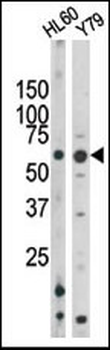
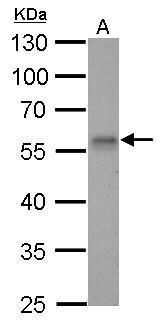
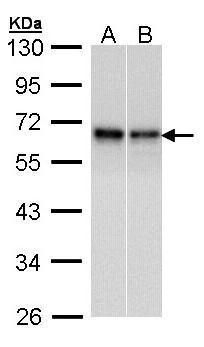
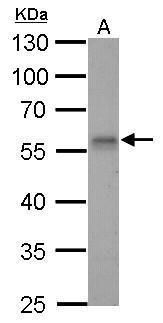
| Tested Applications | ELISA, WB |
|---|---|
| Dilution Range | ELISA: 1:10,000 - 1:50,000, WB: 1:500- 1:2,000 |
| Reactivity | Yeast |
| Application Notes |
Key Properties
−| Antibody Type | Primary Antibody |
|---|---|
| Host | Rabbit |
| Clonality | Polyclonal |
| Isotype | IgG |
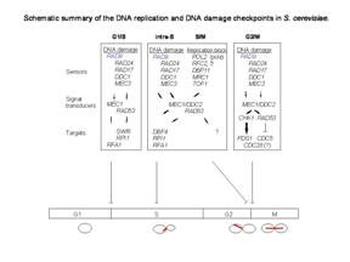
| Immunogen | This affinity purified antibody was prepared from whole rabbit serum produced by repeated immunizations with a synthetic peptide corresponding to an internal region near aa 1120-1145 from the aa1309 yeast Rad9 protein conjugated to KLH. |
| Target | RAD9 |
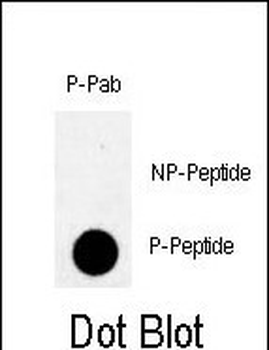
| Purity | This affinity purified antibody is directed against the phosphorylated form of yeast Rad9 at the pS1129 residue. The product was affinity purified from monospecific antiserum by immunoaffinity purification. Antiserum was purified against the immunizing peptide. This phosphor polyclonal antibody reacts with the phosphorylated Rad9 pS1129 and minimally with non-phosphorylated yeast Rad9 at S1129. No reactivity is expected against human and mouse homologs. Reactivity to Rad9 from others sources is unknown. |
| Conjugation | Unconjugated |
Storage & Handling
−| Storage | Store vial at -20° C prior to opening. Aliquot contents and freeze at -20° C or below for extended storage. Avoid cycles of freezing and thawing. Centrifuge product if not completely clear after standing at room temperature. This product is stable for several weeks at 4° C as an undiluted liquid. Dilute only prior to immediate use. |
|---|---|
| Form/Appearance | Liquid (sterile filtered) |
| Buffer/Preservatives | Preservative: 0.01% (w/v) Sodium Azide. Stabilizer: None; Buffer: 0.02 M Potassium Phosphate, 0.15 M Sodium Chloride, pH 7.2 |
| Concentration | 0.43 mg/mL |
| Expiration Date | 12 months from date of receipt. |
| Dry Ice Shipping | Please note: This product requires shipment on dry ice. A dry ice surcharge will apply. |
| Disclaimer | For research use only |
Alternative Names
−Rabbit anti-Rad9 phospho antibody, Rabbit anti-Rad9 pS1129 antibody, Rad 9, Rad-9, Cell cycle checkpoint control protein antibody, Cell cycle checkpoint control protein RAD9A antibody, DNA repair exonuclease rad9 homolog A antibody, DNA repair protein RAD9, YDR217C, YD9934.02C
Similar Products
−- Item 1 of 12
RAD9 Rabbit Polyclonal Antibody [orb4733]
IF, IHC-Fr, IHC-P, WB
Canine, Gallus, Human, Porcine, Rabbit
Mouse, Rat
Rabbit
Polyclonal
Unconjugated
50 μl, 100 μl, 200 μl - Item 1 of 6
Rad9/Rad9a Rabbit Polyclonal Antibody [orb654461]
ELISA, FC, IHC, WB
Mouse, Rat
Rabbit
Polyclonal
Unconjugated
100 μg - Item 1 of 5
Phospho-RAD9 (Tyr28) Rabbit Polyclonal Antibody [orb4741]
IF, IHC-Fr, IHC-P, WB
Bovine, Equine, Human, Porcine, Rabbit
Mouse, Rat
Rabbit
Polyclonal
Unconjugated
50 μl, 100 μl, 200 μl - Item 1 of 3
Phospho-RAD9(S328) Antibody [orb34504]
DOT, IHC-P, WB
Human
Rabbit
Polyclonal
Unconjugated
50 μl, 100 μl - Item 1 of 5
Rad9 Rabbit Polyclonal Antibody [orb555875]
ICC, IHC-P, WB
Human, Mouse, Rat
Rabbit
Polyclonal
Unconjugated
100 μl


Quality Guarantee
Explore bioreagents carefree to elevate your research. All our products are rigorously tested for performance. If a product does not perform as described on its datasheet, our scientific support team will provide expert troubleshooting, a prompt replacement, or a refund. For full details, please see our Terms & Conditions and Buying Guide. Contact us at support@biorbyt.com.
Quick Database Links
UniProt Details
− No UniProt data available
NCBI Reference Sequences
−Associated Accession Numbers
Curated reference sequences for the gene transcript and protein product| Protein | NP_010503.1 |
|---|
Protocol Information
WB
Western Blot (IB, immunoblot)
ELISA
Enzyme-linked Immunosorbent Assay (EIA)