
You have no items in your shopping cart.
Fructose 6 Phosphate Kinase (PFKM) Antibody (C-term)
SKU: orb1928573
Description
Research Area
Pharmacology & Drug Discovery
Images & Validation
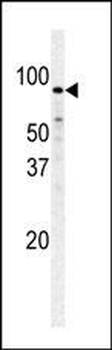
−
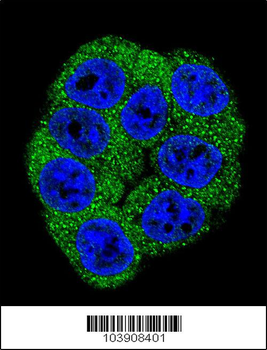
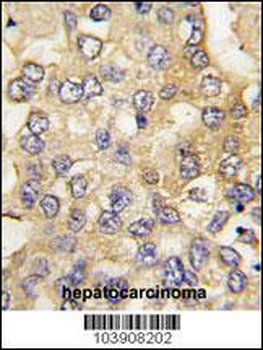
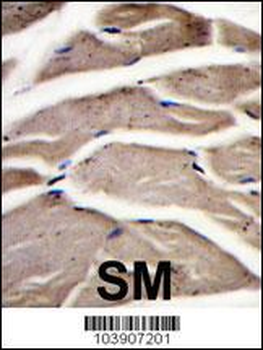
Item 1 of 4
| Tested Applications | IF, IHC-P, WB |
|---|---|
| Dilution Range | IF - 1:10-50, WB - 1:1000, IHC-P - 1:50-100 |
| Reactivity | Human |
| Predicted Reactivity | Monkey |
Key Properties
−| Antibody Type | Primary Antibody |
|---|---|
| Host | Rabbit |
| Clonality | Polyclonal |
| Isotype | Rabbit IgG |
| Immunogen | This Fructose 6 Phosphate Kinase (PFKM) antibody is generated from rabbits immunized with a KLH conjugated synthetic peptide between 746-776 amino acids from the C-terminal region of human Fructose 6 Phosphate Kinase (PFKM). Antigen Region: 746-776 aa. |
| Target | PFKM |
| Molecular Weight | 85183 Da |
| Conjugation | Unconjugated |
Storage & Handling
−| Storage | Maintain refrigerated at 2-8°C for up to 2 weeks. For long term storage store at -20°C in small aliquots to prevent freeze-thaw cycles |
|---|---|
| Form/Appearance | Purified polyclonal antibody supplied in PBS with 0.09% (W/V) sodium azide. This antibody is prepared by Saturated Ammonium Sulfate (SAS) precipitation followed by dialysis against PBS. |
| Expiration Date | 12 months from date of receipt. |
| Disclaimer | For research use only |
Alternative Names
−ATP-dependent 6-phosphofructokinase, muscle type {ECO:0000255|HAMAP-Rule:MF_03184}, ATP-PFK {ECO:0000255|HAMAP-Rule:MF_03184}, PFK-M, 27111 {ECO:0000255|HAMAP-Rule:MF_03184}, 6-phosphofructokinase type A, Phosphofructo-1-kinase isozyme A, PFK-A, Phosphohexokinase {ECO:0000255|HAMAP-Rule:MF_03184}, PFKM, PFKX

Quality Guarantee
Explore bioreagents carefree to elevate your research. All our products are rigorously tested for performance. If a product does not perform as described on its datasheet, our scientific support team will provide expert troubleshooting, a prompt replacement, or a refund. For full details, please see our Terms & Conditions and Buying Guide. Contact us at support@biorbyt.com.
Quick Database Links
UniProt Details
− No UniProt data available
NCBI Reference Sequences
−Associated Accession Numbers
Curated reference sequences for the gene transcript and protein productProtocol Information
WB
Western Blot (IB, immunoblot)
IHC-P
Immunohistochemistry Paraffin
IF
Immunofluorescence
Filter by Applications
Filter by Species
Ying Yang, Mari B. Ishak Gabra, Eric A. Hanse, Xazmin H. Lowman, Thai Q. Tran, Haiqing Li, Neta Milman, Juan Liu, Michael A. Reid, Jason W. Locasale, Ziv Gil, Mei Kong MiR-135 suppresses glycolysis and promotes pancreatic cancer cell adaptation to metabolic stress by targeting phosphofructokinase-1 Nature Communications, 10, 809 (2019)
Applications
IHC
Reactivity
Human
Available Sizes
Select a size below
Choose Conjugation or Carrier Free Version
Free Secondary Antibody (20 ul)0/0
Please add an antibody product to your cart first.
 Usually dispatched within 5-10 working days