
You have no items in your shopping cart.

Membrane Transport Proteins
SLC - Solute Carrier Superfamily
Facilitating the transport of a wide variety of vital substrates and small molecules across biological membranes.
Solute carriers (SLC) are a massive group of membrane transport proteins, comprising over 300 members, most of which are natively located in cell membranes. Their main function is to carefully facilitate the transport of a wide variety of substrates across biological membranes, including the critical uptake of small molecules into cells.
The SLC superfamily of solute carriers is the second largest family of membrane proteins after G protein-coupled receptors. Within the superfamily, there is a great diversity of structure, but they are united by their overarching transport function. Over 50 unique families have been identified based on sequence similarities, though many of them heavily overlap in terms of the specific solutes that they carry.
Functional Diversity: Functionally, members can be divided into those dependent on gradients of ions (particularly sodium, chloride, or protons), exchange of solutes, or simple equilibrative gating. For many members, the stoichiometry of transport is not yet established.
- Two families (SLC3 and SLC7) only generate functional transporters as heteromeric partners, where one partner is a single trans-membrane domain protein.
- One specific family of transporters also possesses active enzymatic activity (SLC27).
- Many members function natively as ion channels (e.g., SLC1A7/EAAT5), heavily increasing the complexity of function of the overall SLC superfamily.
1. Membrane Transporters
Membrane transporters are widely and constitutively expressed throughout the body. They are found heavily concentrated in the epithelia of major organs, such as the liver, intestine, and kidney, and in organs with critical barrier functions, such as the brain, testes, and placenta.
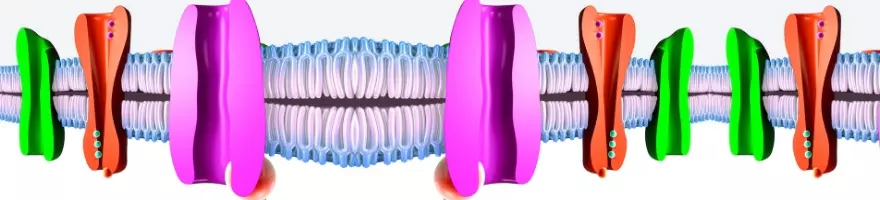
Different specific transporters are localised to the plasma membrane, as well as to the highly restrictive membranes of various subcellular organelles. This maintains cellular homeostasis due to the tightly regulated delivery of required substrates. SLC transporters therefore possess highly important roles in physiological processes ranging from the cellular uptake of key nutrients to the systemic absorption of therapeutic drugs and other xenobiotics.
2. ATP-binding cassette (ABC) Superfamily
Traditionally, a significantly greater emphasis has been placed by the pharmaceutical industry on the development of drugs targeted at the other major transporter superfamily: the ATP-binding cassette (ABC) superfamily.
Fewer therapeutic drugs have been developed to explicitly exploit SLC family targets, but global research interest in this incredibly diverse family of proteins is rapidly growing. Several classes of highly successful marketed drugs now definitively target well-known SLC transporters (such as neurotransmitter transporters). Furthermore, modern human genetic studies have provided powerful insight into the roles of more-recently characterised SLC transporters in both rare and common diseases, indicating an enormous wealth of new therapeutic opportunities.
3. Available SLC Targets
Biorbyt provides an extensive range of highly validated primary antibodies and recombinant proteins for studying solute carrier mechanisms. Click any target below to explore available reagents.