
You have no items in your shopping cart.
Mouse IgG1 Lambda isotype Control Antibody
SKU: orb343762
Description
Research Area
Protein Biochemistry
Images & Validation
−
Item 1 of 2
| Tested Applications | ELISA, FC, SDS-PAGE |
|---|---|
| Dilution Range | FC: 1:1000-1:5000 |
| Application Notes |
Key Properties
−| Isotype | IgG1 |
|---|---|
| Clone No. | MG1L |
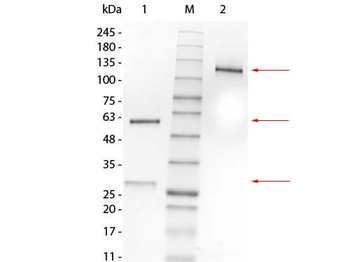
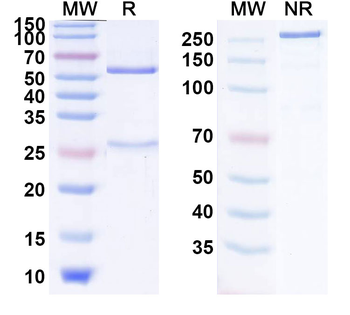
| Purity | Mouse Isotype control has been prepared from concentrated cell culture supernatant by immunoaffinity chromatography using protein A. Assay by immunoelectrophoresis resulted in a single precipitin arc against anti-Mouse IgG and anti-Mouse serum. Isotyping assay resulted non-reactive with antisera to mouse IgG2a, IgG2b, IgG3, IgA, IgM. Light chain composition has been confirmed by SDS-PAGE. |
| Conjugation | Unconjugated |
Storage & Handling
−| Storage | Store vial at 4° C prior to opening. Mouse IgG1 Lambda isotype control is stable 4° C as an undiluted liquid. Dilute only prior to immediate use. For extended storage mix with an equal volume of glycerol, aliquot contents and freeze at -20° C or below. Avoid cycles of freezing and thawing. |
|---|---|
| Form/Appearance | Liquid (sterile filtered) |
| Buffer/Preservatives | Preservative: 0.01% (w/v) Sodium Azide. Stabilizer: None; Buffer: 0.02 M Potassium Phosphate, 0.15 M Sodium Chloride, pH 7.2 |
| Concentration | 1.0 mg/mL |
| Expiration Date | 12 months from date of receipt. |
| Disclaimer | For research use only |
Alternative Names
−Mouse immunoglobulin gamma lambda, Mouse IgG1 isotype control, Mouse IgG1 Lambda
Similar Products
−- Item 1 of 1

Quality Guarantee
Explore bioreagents carefree to elevate your research. All our products are rigorously tested for performance. If a product does not perform as described on its datasheet, our scientific support team will provide expert troubleshooting, a prompt replacement, or a refund. For full details, please see our Terms & Conditions and Buying Guide. Contact us at support@biorbyt.com.
Protocol Information
FC
Flow Cytometry
ELISA
Enzyme-linked Immunosorbent Assay (EIA)
SDS-PAGE
Sodium Dodecyl Sulphate PolyAcrylamide Gel Electrophoresis
Available Sizes
Select a size below
Free Secondary Antibody (20 ul)0/0
Please add an antibody product to your cart first.
 Usually dispatched within 5-10 working days