Cart summary

You have no items in your shopping cart.

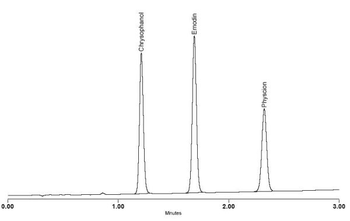
Chrysophanol

SKU: orb1304759

Description

Chrysophanol is a natural anthraquinone found in plants like rhubarb and sorrel, functioning as a dual inhibitor of the EGFR and mTOR signaling pathways. It is utilized in biochemical research for investigating cell proliferation and apoptosis, with studies demonstrating its activity in both in vitro and in vivo cancer models.

Research Area

Cardiovascular Research, Signal Transduction

Images & Validation

Key Properties

CAS Number481-74-3
MW254.24
Purity99.70%
FormulaC15H10O4
SMILESCc1cc(O)c2C(=O)c3c(O)cccc3C(=O)c2c1
TargetEGFR
SolubilityH2O:< 1 mg/mL (insoluble or slightly soluble);Ethanol:< 1 mg/mL (insoluble or slightly soluble);DMSO:1.64 mg/mL (6.45 mM)

Bioactivity

In Vivo
Chrysophanol (CA) has been shown to counteract obesity in C57BL/6 mice induced by a high-fat diet (HFD). Through in vivo studies involving male C57BL/6J mice, it was discovered that Chrysophanol significantly mitigates weight gain associated with HFD consumption. Specifically, mice subsisting on an HFD without Chrysophanol treatment experienced a weight increase of 23.92 ± 1.74 g over 16 weeks. In contrast, mice treated with Chrysophanol exhibited a markedly lower weight gain of 16.72 ± 2 g in the same period, underscoring Chrysophanol's potential as an effective intervention against HFD-induced obesity.
Cell Research
Chrysophanol (Chrysophanic Acid) is dissolved in DMSO and stored, and then diluted with appropriate medium before use. The cells are seeded at 5×10³ cells/mL in 96-well microplates and allowed to attach for 24 h. Chrysophanol (20, 50, 80 and 120 μM) is added to the medium at various concentrations up to 120 μM and for different durations. After treatment, cell cytotoxicity and/or proliferation is assessed by a Cell Counting Kit-8 (CCK-8). Briefly, highly water-soluble tetrazolium salt, WST-8, produces an orange colored water-soluble product, formazan. The amount of formazan dye generated by dehydrogenases in cells is directly proportional to the number of living cells.CCK-8 (10 μL) is added to each well and incubated for 3 h at 37°C, then cell proliferation and cytotoxicity are assessed by measuring the absorbance at 450 nm using a microplate reader.Three replicated wells are used for each experimental condition.

Storage & Handling

StoragePowder: -20°C for 3 years | In solvent: -80°C for 1 year | Shipping with blue ice/Shipping at ambient temperature.
Expiration Date12 months from date of receipt.
DisclaimerFor research use only

Alternative Names

Chrysophanic Acid, Chrysophanol, 3-Methylchrysazin, inhibit, EGFR, ErbB-1, Epidermal growth factor receptor, Inhibitor, HER1, Turkey Rhubarb

Similar Products

Quality Guarantee

Quality Guarantee

Explore bioreagents carefree to elevate your research. All our products are rigorously tested for performance. If a product does not perform as described on its datasheet, our scientific support team will provide expert troubleshooting, a prompt replacement, or a refund. For full details, please see our Terms & Conditions and Buying Guide. Contact us at [email protected].

Key Properties

No computed properties available.

Documents Download

Datasheet
Product Information
Download

Request a Document

Protocol Information

Chrysophanol (orb1304759)

  • Star
  • Star
  • Star
  • Star
  • Star
  • 0.0
Based on 0 reviews

Participating in our Biorbyt product reviews program enables you to support fellow scientists by sharing your firsthand experience with our products.

Login to Submit a Review

No reviews yet

Step 1: Enter information below

(Recommended: An additional animal making an allowance for loss during the experiment)

Step 2: Enter the in vivo formulation

(This is only the calculator, not formulation. Please contact us first if there is no in vivo formulation at the solubility Section.)

% DMSO +
%+
% Tween 80 +
%

Available Sizes

Select a size below

50 mg
$ 80.00
100 mg
$ 90.00
DispatchUsually dispatched within 3-5 working days
Bulk Enquiry