
You have no items in your shopping cart.
Tumour Necrosis Factors (TNFs)
Master regulators of immune responses, inflammation, and programmed cell death.
Tumour Necrosis Factor (TNF) proteins are a prominent group of cytokines—signaling molecules fundamentally involved in systemic inflammation and making up one of the acute phase proteins that initiate the inflammatory cascade. They govern diverse aspects of immune function, cell survival, and apoptosis (programmed cell death), making them crucial targets for therapeutic intervention in inflammatory and autoimmune diseases.
Clinical Context: Dysregulation of TNF production has been implicated in a variety of human diseases including Alzheimer's disease, cancer, major depression, psoriasis, and inflammatory bowel disease (IBD). Anti-TNF therapies are among the most widely prescribed biologics worldwide.
TNF-Alpha (TNF-α)
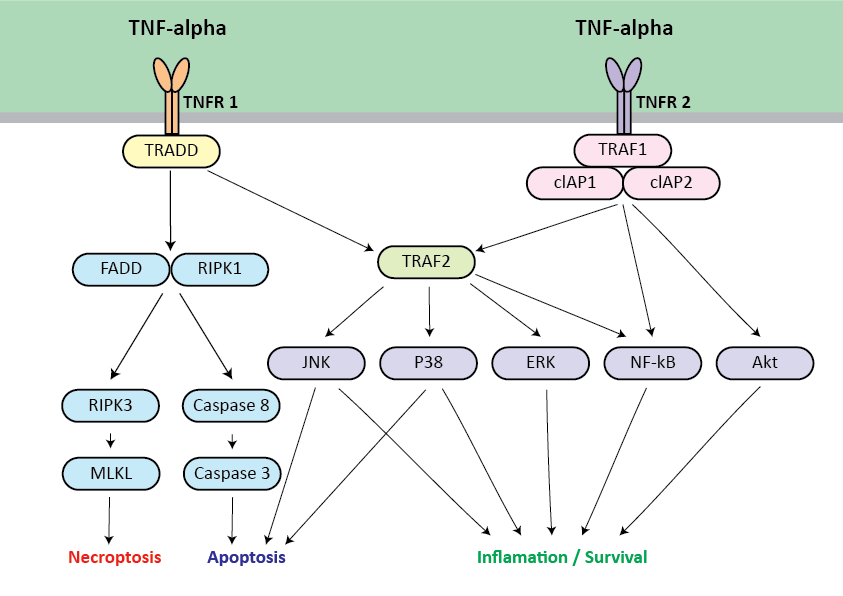
TNF-α is the most well-known and extensively studied TNF protein. It is primarily produced by activated macrophages, although other cell types such as lymphocytes, mast cells, endothelial cells, and fibroblasts can also secrete it. TNF-alpha plays a crucial role in the regulation of inflammation, immune response, and the induction of apoptosis via the TNF Receptor 1 (TNFR1) and TNF Receptor 2 (TNFR2) signaling cascades.
TNF-Beta (TNF-β) / Lymphotoxin-alpha (LT-α)
Historically known as TNF-β, this protein is now more commonly referred to as Lymphotoxin-alpha (LT-α). It is produced primarily by activated T lymphocytes and natural killer (NK) cells. While it shares 30% sequence homology with TNF-α and binds to the same receptors, its functions are distinct. TNF-β is intimately involved in lymphoid tissue development and organization (organogenesis) and contributes to the activation of other immune cells in maintaining secondary lymphoid organs.
Other TNF Superfamily Members
Beyond the classical alpha and beta forms, the wider TNF Ligand Superfamily (TNFSF) consists of structurally related cytokines with diverse functions in immune regulation, cell survival, and apoptosis. Key members include:
- TRAIL (Tumor Necrosis Factor-Related Apoptosis-Inducing Ligand): Known for its ability to induce apoptosis selectively in tumor cells while sparing normal cells.
- TNFSF10: The official gene designation for TRAIL.
- TWEAK (Tumor Necrosis Factor-Related Weak Inducer of Apoptosis): A multifaceted cytokine regulating cell proliferation, angiogenesis, and inflammation.
- TNFSF13 (also known as APRIL - A Proliferation-Inducing Ligand): Crucial for B-cell maturation and survival.
Featured TNF Research Reagents
To support your immunology and cancer research, Biorbyt offers a comprehensive catalogue of highly validated TNF bioreagents. Explore our top categories for functional assays, protein detection, and cell culture:
Recombinant Proteins Active TNF Cytokines Bioactive, high-purity recombinant TNF-α and related superfamily proteins tailored for cell culture, apoptosis assays, and functional studies. Primary Antibodies Anti-TNF Antibodies Highly specific monoclonal and polyclonal antibodies validated for Western Blot, IHC, ICC/IF, and Flow Cytometry. Detection Kits TNF ELISA Kits Ready-to-use sandwich ELISA kits for the precise quantification of TNF proteins in serum, plasma, and cell culture supernatants. Biochemicals Biomolecules & Reagents A comprehensive selection of specialized biochemicals, including metabolites, lipids, and enzyme substrates to support robust assay development.