
You have no items in your shopping cart.
I. Major Scientific Findings: Paradigm Shift in Glioblastoma (GBM) Biology
- This landmark Nature publication fundamentally reframes glioblastoma—the most aggressive primary brain malignancy—by demonstrating that tumor cells are not merely proliferative masses, but sophisticated components that actively and functionally integrate into the host's native neural circuitry.
A. Central Discovery: Functional Synaptic Integration
- The researchers established that human GBM cells form robust, functional synapses with healthy neurons, a discovery facilitated by viral tracing techniques (rabies and herpes simplex virus). This established that GBM cells actively receive neuronal signals, allowing them to hijack the brain's own communication lines.
-
- Cholinergic Modulation: A key finding was the identification of cholinergic neuromodulatory input originating from the basal forebrain. These signals are critical, as they control global alertness and network dynamics in healthy tissue.
- Mechanism and Motility: The study demonstrated that exposure to the neurotransmitter acetylcholine induces a powerful, long-lasting increase in calcium oscillations within the GBM cells. This electrical stimulation triggers a definitive transcriptional reprogramming within the tumor, making the cells significantly more motile and invasive—a primary driver of tumor progression and poor prognosis.
B. Therapeutic Target Identification
- The investigation isolated the metabotropic CHRM3 receptor on the surface of GBM cells as the specific molecular transducer responsible for receiving and amplifying the damaging cholinergic signal. Downregulating this singular receptor significantly suppressed tumor cell motility and successfully prolonged survival in relevant mouse models, establishing CHRM3 as a highly promising, novel therapeutic vulnerability for GBM.

Rapid neuronal circuit integration of transplanted human GBM cells in the adult mouse brain. II. Reagent Specification and Validation
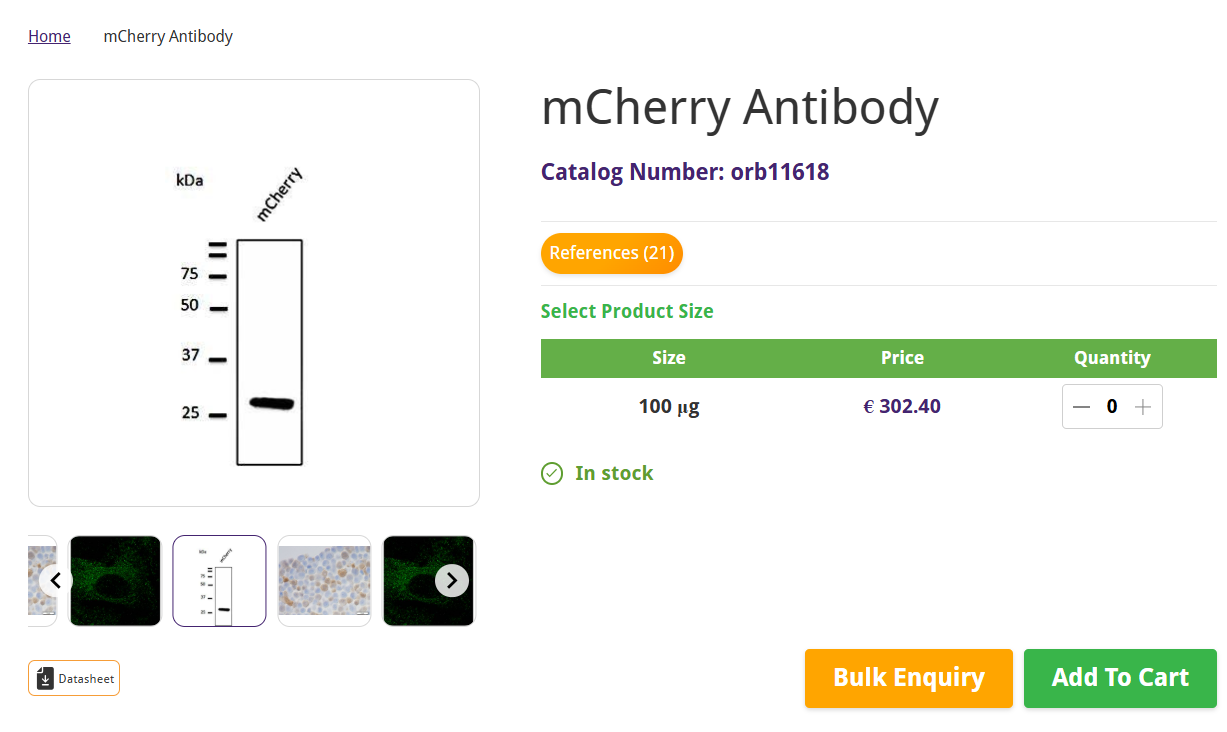
- The essential detection reagent used in this study—the Goat anti-RFP/mCherry (orb11618)—is Biorbyt's premium, rigorously validated polyclonal antibody, crucial for signal amplification in complex tissue environments.
- Catalog Identity: Goat anti-RFP/mCherry (Biorbyt, orb11618)
Study Application: Used at a potent 1:500 dilution for Immunofluorescence (IF).
Validation: This Goat polyclonal antibody has been thoroughly validated for core immunological applications, demonstrating exceptional specificity across Western Blot (WB), Immunohistochemistry (IHC), and Immunofluorescence (IF). - The utility of the orb11618 antibody extends far beyond this study, underscoring its reliability in advanced neuroscience and oncology research.
- Widespread Citation: The antibody's performance is evidenced by its adoption in over 21 peer-reviewed publications, including high-impact journals such as Nature, Nature Biotechnology, Immunity, Nature Cancer, and Nature Neuroscience, contributing to a cumulative Impact Factor exceeding 320.
- Biorbyt supports diverse labeling needs with a wide portfolio of validated reagents:
- Other Fluorescent Protein Antibodies: tdTomato antibody (orb182397) and GFP-tag antibody (orb323045).
- If your research requires highly specific, cited fluorescent protein antibodies, please contact our technical team for inquiries or explore our complete catalog: https://www.biorbyt.com/anti-mcherry-orb11618.html
- Catalog Identity: Goat anti-RFP/mCherry (Biorbyt, orb11618)
- PUBLICATION: Sun Y, Wang X, Zhang DY, Zhang Z, Bhattarai JP, Wang Y, Park KH, Dong W, Hung YF, Yang Q, Zhang F, Rajamani K, Mu S, Kennedy BC, Hong Y, Galanaugh J, Sambangi A, Kim SH, Wheeler G, Gonçalves T, Wang Q, Geschwind DH, Kawaguchi R, Viaene AN, Helbig I, Kessler SK, Hoke A, Wang H, Xu F, Binder ZA, Isaac Chen H, Pai EL, Stone S, Nasrallah MP, Christian KM, Fuccillo M, Toni N, Wu Z, Cheng HJ, O'Rourke DM, Ma M, Ming GL, Song H. Brain-wide neuronal circuit connectome of human glioblastoma. Nature. 2025 May;641(8061):222-231. doi: 10.1038/s41586-025-08634-7. Epub 2025 Jan 16. PMID: 39821165; PMCID: PMC12347542.